Agent Tool Retry and Fallback Patterns for Flaky External APIs
Build resilience into agent pipelines with retry logic, circuit breakers, and fallback chains.
AI agents don't fail like normal software. There's no stack trace, no NullPointerException stopping the program in its tracks. Instead, a tool call comes back with a 429, or it times out silently, or it returns a 200 OK wrapped around garbage. The failure is probabilistic, and that changes everything about how you build around it. LLM API calls fail somewhere in the range of 1 to 5 percent of the time, from rate limits, timeouts, or server errors on the provider's end. That number sounds trivial in a dev environment where you're running a handful of test calls a day. At production scale, running thousands of tool calls an hour across a multi-agent pipeline, even a small failure rate turns into a steady drip of broken workflows. And without retry logic, one failed call in a chained pipeline doesn't just fail that step. It stops the entire run.
Classifying failures before reaching for retry logic
The instinct to wrap every tool call in a retry loop is understandable, and wrong. Retrying only makes sense for certain kinds of failure. Retry the wrong kind, and you burn token budget and time on a call that was never going to succeed.
Start with three buckets. Transient failures clear up on their own within seconds, such as a 429 rate limit, a brief network hiccup, or a momentary blip on the provider's side. Retry logic handles these. Persistent failures don't resolve no matter how long you wait: a full provider outage, or an API that's been returning bad output for the last hour. Retrying these just wastes tokens and delays the moment you actually route around the problem. Then there's the sneaky one: quality failures, where the API call succeeds, returns a 200, and hands back an answer that's simply wrong. No error fires. Nothing about the response looks broken on the surface.
A more formal breakdown splits failures into four categories, each with its own fix. Execution errors, things like failed tool invocations or API calls, get handled with circuit breakers and retries. Semantic errors, meaning output that's syntactically fine but factually or logically off, need validation layers and semantic fallbacks instead. State errors, where the agent's internal assumptions no longer match reality, call for state verification and checkpointing. Timeout and latency failures need adaptive timeouts paired with partial result extraction, so a slow response doesn't force you to throw away everything up to that point.
The practical rule: classify before you retry. Transient errors get exponential backoff with jitter. Structural failures and low-confidence outputs skip the retry step entirely and bypass the retry loop. Retrying a structural problem doesn't fix it, it just delays the moment someone finds out.
Exponential backoff with jitter as the baseline retry pattern
Once you've confirmed a failure is transient, backoff is the default response. The logic is simple: each retry waits longer than the last, doubling the delay every time. Retry 1 waits a second, retry 2 waits two seconds, retry 3 waits four, retry 4 waits eight. The doubling gives a struggling service room to recover instead of getting hit with the same load, over and over, at the same intensity.
Fixed-interval retries don't do this. If every failed call retries after exactly the same delay, and hundreds of agent calls hit the same rate limit at once, they all retry at the same moment too. That's a retry storm, and it's often what turns a brief service hiccup into a sustained outage: the retries themselves become the load that keeps the service down.
Jitter is the fix. Instead of retrying at a clean, calculated delay, add a small random offset on top: wait_time = (base_delay × 2^attempt) + random(0, jitter_max). Spread retries across a window instead of firing them all at the exact same instant, and the upstream service actually gets a chance to catch up. Available data on the pattern shows that backoff with jitter cuts retry storms by 60 to 80 percent, so a rate limit clears in ten seconds instead of spiraling for minutes.
Circuit breakers: stopping retry traffic from harming an already-struggling dependency
Backoff assumes the dependency will recover soon. Sometimes it won't. If a CRM integration has been throwing 503s for several minutes straight, every retry, even a well-spaced one with jitter, is still a wasted request. It burns token budget, adds latency, and does nothing for a provider that isn't coming back anytime soon.
Circuit breakers exist for exactly this. They track three states. Closed is normal: requests flow through as usual. Open triggers once failures cross a defined threshold: the agent stops sending requests entirely and fails fast, no tokens spent, no latency wasted waiting on a call that won't succeed. Half-Open comes after a cooldown period, when the breaker allows a single test request through. Succeed, and the circuit closes again. Fail, and it reopens, resetting the cooldown clock.
The threshold itself is a judgment call. Sourced figures put common thresholds around 5 consecutive failures, or an error rate above 15 percent within a 60-second window, though the right number depends on how much latency a given pipeline can tolerate before failing fast becomes the smarter move. What a tripped circuit buys you is an immediate, actionable signal: instead of grinding through a multi-second timeout on every single call, the agent knows right away that it's time to fall back, serve something cached, or flag a human.
Fallback chains: what the agent does when retries and circuit breakers are exhausted
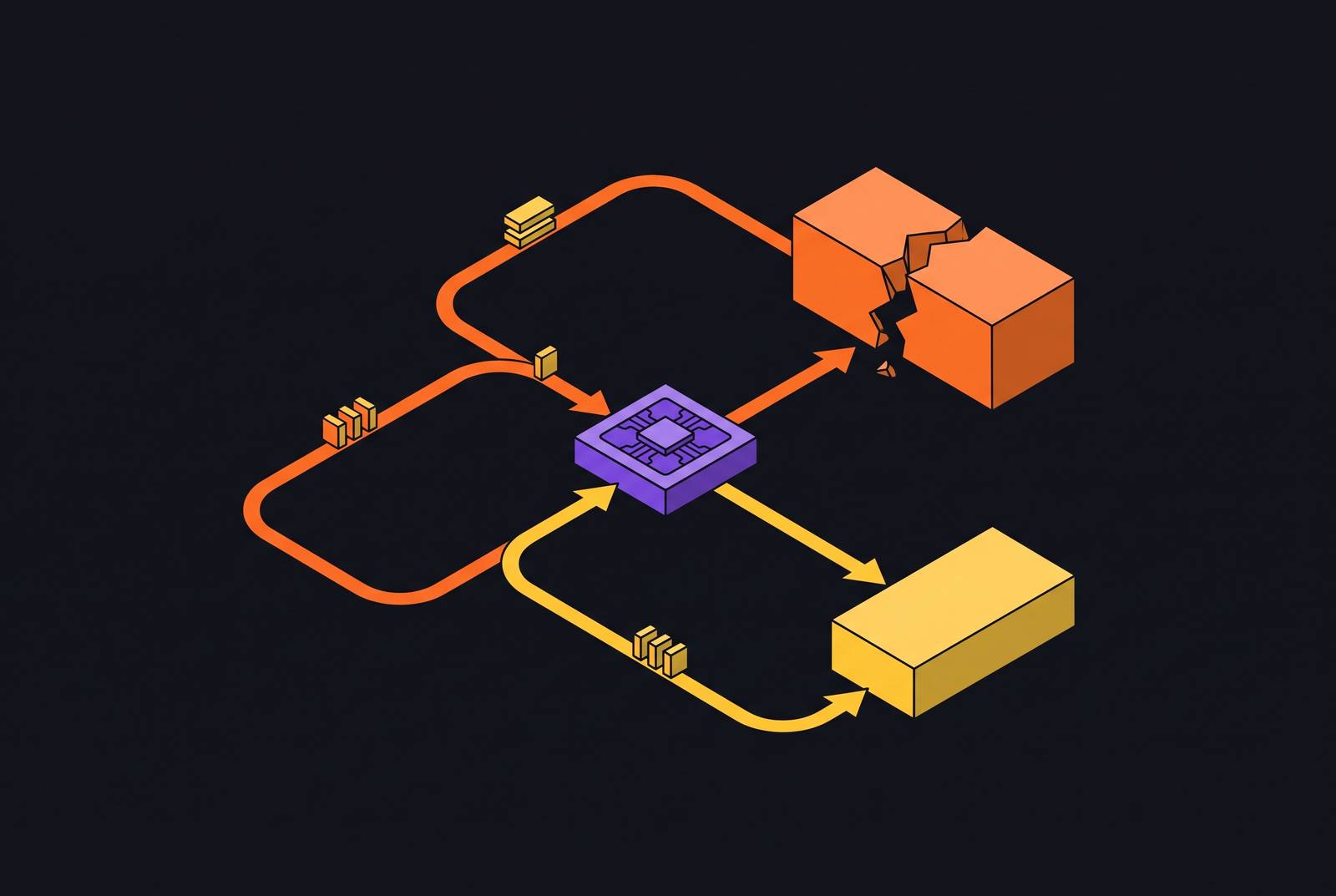
Retries buy time. Circuit breakers stop wasted effort. Fallback chains decide what actually happens next, and there are a handful of architecture patterns that cover most of what shows up in production.
Sequential chains are the simplest: try tool A, and if it fails, move to tool B. Good for linear workflows where the failure modes are predictable and there's a clear backup for each step. Router or dispatcher patterns classify the input first, then send it to whichever tool fits, which matters a lot when a single pipeline handles mixed inputs (say, a document ingestion system that sees PDFs, scanned images, and structured forms all in the same queue) without needing a separate pipeline for each type. Retry-with-fallback pairs a fast, cheap primary path with a slower, more capable escalation path, triggered only when the primary comes back with a low-confidence result. And human-in-the-loop escalation kicks in after N retries: the workflow pauses and waits for a person to step in and resolve it.
Multi-LLM fallback deserves its own mention. Try the primary model first. If it's down, or if it returns something clearly degraded, fall back to a faster or cheaper alternative rather than stopping the pipeline. That's a deliberate trade: reduced quality is a better outcome than no output at all, which is exactly the trade-off high-availability pipelines are built to make.
Human escalation earns its keep in domains where being wrong costs more than being slow: invoice generation, contract analysis, document processing generally. In those cases, the agent creates a task or notification, pauses the workflow, and picks back up once a human resolves it. Speed isn't the priority there. Correctness is.
For agents whose primary tool is live web data, a fallback to cached content is often the right way to degrade. A retrieval pipeline grounded on stale but clearly-labeled data usually beats one that returns nothing, as long as the staleness is surfaced rather than hidden. An agent that silently serves week-old data as if it were fresh is arguably worse than one that fails loudly.
Handling quality failures: when the API succeeds but the output is wrong
Quality failures are the hardest category precisely because nothing about them looks like a failure. The API returns 200. The JSON parses cleanly. The downstream system takes that plausible-looking payload and keeps processing, no errors raised anywhere in the chain. Whatever's wrong with the data often stays hidden until much later, and sometimes it never surfaces.
Three patterns occur often enough to design around directly. Response format drift happens when a provider updates a model and the structured output that used to match your prompt shifts, subtly, in ways that don't throw an error but do break your parsing logic downstream. Partial or malformed responses look complete on the surface but are missing fields or truncated in ways that corrupt processing without ever raising an exception. And hallucinated tool calls are maybe the sneakiest: syntactically valid JSON, correctly formatted, wrapping a function name or argument that was never real to begin with.
Schema-driven validation is the main defense against all three. Define what a correct response looks like as a typed JSON schema, and validate every single response against it before anything downstream touches it. Field-level confidence scores add another layer: high-confidence results move straight to automated processing, low-confidence ones get flagged for human review instead of sliding through on the strength of well-formed syntax alone. Beyond catching bad output, a well-built schema narrows the whole retry problem. When field types, confidence thresholds, and what happens on missing data are all spelled out ahead of time, the agent classifies a failure correctly on the first pass, instead of shoveling ambiguous output into a generic retry loop that was never designed to catch it.
Observability: making failure visible across the full retry and fallback chain
Without tracing, a pipeline that quietly retried three times, fell back to a secondary model, and returned a degraded answer looks exactly the same from the outside as one that succeeded cleanly on the first try. That's a problem, because the two outcomes are not the same, and treating them as identical is how quality erosion goes unnoticed for weeks.
A handful of things worth logging as a baseline are every retry attempt, tagged with which tool, which error class, which attempt number, and the delay applied. Circuit breaker transitions, recorded whenever a breaker opens, moves to half-open, or closes back up. Fallback activations, noting which fallback fired, why the primary wasn't available, and what the fallback actually returned. And quality validation failures: schema mismatches, confidence scores that dropped below threshold, any case that triggered a human escalation.
An observability setup that only traces the LLM call itself misses most of this. What matters is tracing the full execution chain, tool invocations included, so a failure three layers deep in a fallback chain is still visible at the top.
Durable state storage matters here too. Long-running agent workflows that crash mid-run and have to restart from zero throw away retries that already consumed real token budget. Storing state persistently means a workflow can resume from where it left off instead of repeating work it already paid for.
Applying the full stack to web data tools in agent pipelines
Web data tools sit at the center of most of this, because they combine nearly every failure mode discussed above into one call. A live fetch can hit a rate limit, time out on a slow-loading page, get blocked outright, or come back with a 200 and a page full of stale, cached, or bot-walled content that looks like real data but isn't.
The layered approach handles each piece separately rather than trying to solve everything with one mechanism. Classify the failure first: a timeout on a slow page is transient, a site that's been down for an hour is persistent, and a page that loaded fine but returned a login wall is a quality failure wearing a success status code. Apply backoff with jitter to the transient cases. Wrap the fetch in a circuit breaker so a site having a genuinely bad day doesn't get hammered by every agent in the pipeline running retries against it simultaneously. Build a fallback chain that has somewhere to go: a cached version of the page, an alternate data source, or a router that redirects to a different extraction method depending on what kind of page came back. Validate the extracted content against a schema before anything downstream treats it as real, since a page that returns valid HTML but empty content is a quality failure no retry will ever fix.
None of these patterns is exotic. Each one solves a narrow, specific problem: backoff buys time, circuit breakers stop wasted effort, fallbacks decide what happens next, and schema validation catches the failures that don't announce themselves. Stacked together, they turn an agent pipeline from something that breaks the first time an external API has a bad afternoon into something that keeps running through it, degraded maybe, but running.