Tool Design for Web-Browsing AI Agents
Reliable web tools, not better models, make AI agents work in production.

AI agents that browse the web are only as good as the tools built for them to see the web through. The market for these agents hit $7.8 billion in 2025 and is on track to pass $10.9 billion in 2026, growing at more than 45% a year. Gartner expects 40% of enterprise applications to ship with task-specific agents by the end of 2026, up from under 5% in 2025. Adoption is running well ahead of the engineering discipline needed to make these agents reliable, and nowhere is that gap wider than in how web tools are designed.
Per the LangChain State of AI Agent Engineering Report (2026), 57% of practitioners already run agents in production. So this isn't a theoretical debate for some future release cycle. It's live, right now, in systems people depend on today.
Every agent runs on a loop: observe, decide, execute, evaluate, repeat. A web tool call sits inside that loop, and it either moves the agent forward or it quietly breaks the whole chain. Most of the failures that get blamed on "the model" actually start upstream, in the tool. Raw HTML gets dumped into context and burns through token budget on nav bars and footer links nobody asked for. A blocked page gets treated like a successful fetch, and the pipeline degrades without anyone noticing. Free-text responses come back with no structure the agent can act on. And when something breaks, the error message doesn't tell the agent whether it hit a timeout, a bot wall, or a plain old 404.
None of that is a model problem. It's a tool design problem, and it breaks down into four parts: output format, fetch reliability, scope, and error contracts. Each one has concrete, learnable patterns behind it.
What the agent actually receives: output format as a first-class design decision
For an agent, format carries as much weight as the data itself. Raw HTML is heavy and noisy, full of scripts and markup the model has to wade through just to find the sentence it needs. That noise costs money and it costs accuracy. Industry benchmarks show that swapping raw HTML for clean Markdown can cut RAG token usage by as much as 60%, while also improving retrieval accuracy, since the model spends its attention on content instead of tags.
There are three output shapes worth knowing, and each fits a different job:
Clean Markdown keeps heading structure intact. Use it for long-form content the agent needs to reason over, or chunk up for retrieval later. Structured JSON, matched to a schema a developer defines ahead of time, is right when the agent needs specific fields (a price, a date, a status flag) rather than a paragraph to read. Plain text strip is the fast, cheap option. Good for a lightweight agent doing a quick fact check on a page whose structure is already known and simple.
Hand the agent raw HTML and ask it to sort out the format itself, and it will. But now it's doing its own parsing, which adds latency, adds a whole new place for things to break, and produces output that isn't even consistent from one run to the next.
Schema-driven JSON sounds like it solves this cleanly, but getting an LLM to comply with a complex schema is its own fight. LLM-based extraction can pull structured output straight from unstructured text, which is genuinely useful. But Han et al. (2023) found GPT-4 threw invalid responses on complex extraction tasks 11.97% of the time. That's not a rounding error, that's more than one in ten calls needing a redo.
Reinforcement learning approaches have pushed that number way down: 98.7% valid JSON against an 82.3% baseline. A "Thought of Structure" method, which has the model reason about the shape of the output before it generates content, showed a 44.89% gain. And the PARSE system, built around components called ARCHITECT and SCOPE, delivered up to a 64.7% improvement in extraction accuracy on the SWDE dataset, with 92% of extraction errors resolved on the very first retry.
Don't assume first-pass compliance. Build retry logic with schema re-validation directly into the tool. Pydantic and JSON Schema, used to type-check tool calls at the boundary, have already cut down malformed calls significantly in 2026-era agent frameworks. That validation belongs at the edge, not buried inside the agent's reasoning.
Build in a response envelope that tells the agent what it's holding before it has to read the whole payload. Content type, whether the result got truncated, a token or character count. Small detail, but it saves the agent from re-parsing a blob just to figure out what kind of blob it is.
Fetch reliability: the upstream problem that output quality cannot fix
AI has taken away the need to hand-write selectors for every page. It has not taken away the need to actually get the page. Something still has to load the HTML, past whatever anti-bot wall sits in front of it, before any model can read a word of it.
In production, the tool that reliably fetches the page and hands back consistent, LLM-ready data wins, full stop. Parsing accuracy is secondary. A perfect extraction schema is worthless against a page that never loaded.
Two failure modes show up constantly, and agents need to tell them apart:
A hard block is something like a Cloudflare challenge screen or a DataDome interstitial. The tool gets a response back. But that response is the block page, not the page the agent asked for, and without a clear signal, the agent has no way of knowing it just ingested garbage dressed up as content.
A soft failure looks different. It's a client-side rendered app or a page with lazy-loaded content, and the tool grabs the HTML before rendering finished. The content looks present. It's actually half-formed.
JS rendering isn't a nice-to-have anymore. Plain HTTP requests against a modern SPA return an empty shell, because the real content only shows up after scripts run client-side.
A fetch layer built for agents needs to handle a few things without being asked twice. Anti-bot bypass and proxy rotation should happen behind the scenes, so the agent never sees a CAPTCHA or a block screen directly. The tool should confirm rendering completed, not just that bytes came back over the wire. And latency should sit in a predictable range, so an agent's timeout logic actually functions the way it's supposed to instead of guessing.
There's a real build-versus-buy question underneath all this. Self-hosted setups like Crawl4AI are free and give full control, along with better privacy since data never leaves the team's own infrastructure. The cost is that someone on the team now owns Playwright runtime upkeep, anti-bot patching, and proxy management, and when anti-bot defenses win, they tend to fail silently, handing back a block page with no flag attached. A managed scraping API takes the browser, proxy rotation, and retry logic off the team's plate entirely, in exchange for cost at scale and dependence on a vendor. The rule of thumb: reach for a managed API when reliable, recurring fetches matter more than shaving cost per page.
Scale changes the calculus, too. A tool that handles ten pages cleanly is not automatically the same tool at ten thousand. Queueing, retries, and rate-limit handling need to live inside the tool's contract. They shouldn't be something the agent has to figure out on its own mid-loop.
Scope: designing tools that match the granularity of the agent's task
Scope is about matching the size of the tool call to the size of the actual task, and getting this wrong quietly wrecks reasoning quality even when everything else works.
Three scope levels cover most agent work:
Single URL to clean content fits a lookup task, where the agent already knows exactly which page has the answer. Site crawl, from a root URL out across subpages, fits a task where the agent has to reason across an entire domain: documentation, a competitor's product catalog, a regulatory filing archive. Interaction session, meaning scrape, click, extract, fits data sitting behind a form, a "Load More" button, a login wall, or a filter dropdown.
That third category used to mean writing a custom Playwright script by hand and babysitting a browser session. Some scraping APIs have begun to expose interaction capabilities as part of their interface, which matters, because a large share of the web's most useful data sits behind exactly that kind of interaction.
Good scope design shows up in the interface itself. A single-URL tool should take a depth parameter, so a caller can ask for link-following without switching to an entirely different tool. Crawl tools should require page-count limits and domain boundaries as inputs, not leave them as defaults, because an unbounded crawl is one of the fastest ways to run up an enormous, unexpected bill. Interaction tools should accept either a natural-language description of the steps or a structured list, and the tool itself, not the agent, should handle executing those steps against a live browser session.
Get scope wrong in either direction and the agent pays for it. Hand back fifty pages when the agent needed one paragraph, and now it burns tokens figuring out what to throw away. That's a real cost, even when the fetch worked and the format was clean. Go too narrow, and the agent ends up chaining calls it was never built to chain, fetching a link, then calling the tool again for that link, and again after that, with latency and error surface multiplying at each hop.
The pattern that holds up in practice: build a small family of composable tools, something like fetch-page, crawl-site, and interact-and-extract, instead of one tool with two dozen flags bolted on. Agents pick the right scope for the job, the surrounding framework routes correctly, and when something fails, it's obvious which piece of the pipeline broke.
Error contracts: what the tool tells the agent when something goes wrong
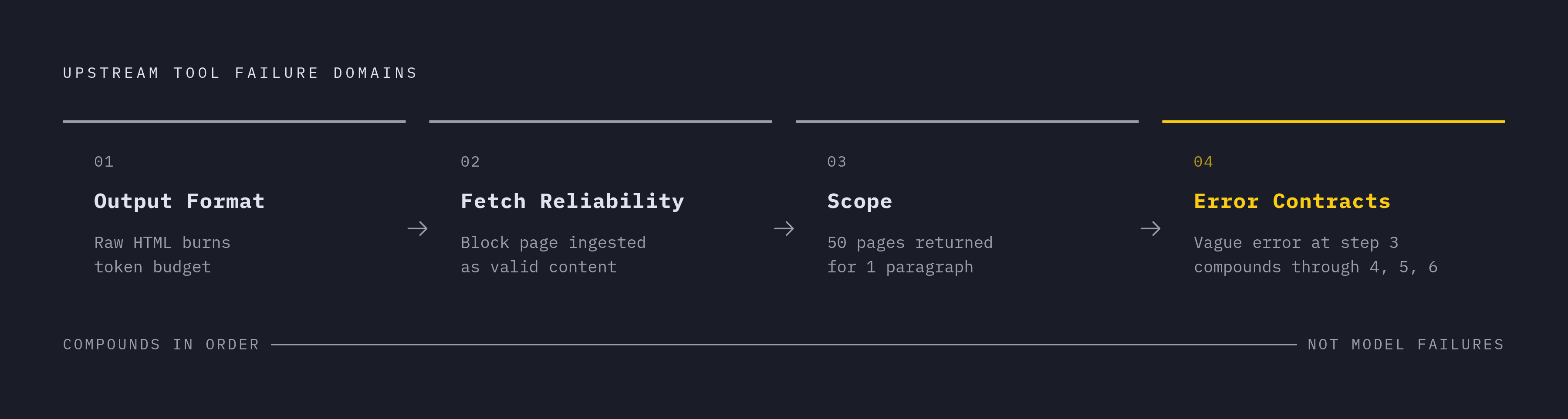
Agents run in loops, which means a vague error at step three doesn't stay contained to step three. It compounds through step four, step five, step six, and by the time a human looks at the output, the actual root cause is buried under three more bad decisions made on top of it.
Four distinct error classes need to be told apart, not collapsed into a generic failure:
A fetch failure means the page was never retrieved. The agent should retry or reroute.
A block or challenge means the page came back, but it's not the target content. This needs its own status, distinct from an outright fetch failure.
A partial render means the page loaded but content extraction ran before rendering finished. Content might be there, but it's incomplete, and the tool should say so explicitly.
An extraction failure means the fetch and render both worked, but structured output came back invalid or empty. The agent needs a signal distinguishing that case from a fetch problem so it can decide whether to retry or escalate.
A solid error envelope carries a few specific things: the error class itself, not a raw HTTP status code the agent then has to interpret; a signal indicating whether the failure is likely transient or structural; an indication of whether anything usable came back alongside the failure; and a suggested next action, not a command, just a hint like "reduce schema complexity" or "target page is behind a login."
Schema validation belongs at the tool boundary. If extraction comes back half-populated, the tool should reject it and return an extraction-failure error, rather than pass a partial object downstream and hope the agent notices something's missing. Downstream steps can't recover data they never knew was absent in the first place.
Retry logic belongs in the tool too, not the agent. The agent's job is to state intent, something like "get the price off this page." The tool should handle retries internally before it ever surfaces a failure back to the caller. Agents that end up managing their own retry loops stop being focused reasoners and turn into fragile orchestrators juggling plumbing they were never designed to juggle.
Choosing and assembling the fetch and extraction layer in 2026
The build-versus-buy question comes down to one thing: is fetch reliability the binding constraint, or is per-page cost? Self-hosted libraries hand over control and cost transparency. Managed APIs hand over fetch reliability, maintained anti-bot bypass, and no infrastructure to babysit.
Crawl4AI is an open-source, async Python library built on Playwright. It returns cleaned Markdown and structured extraction output, and supports chunking strategies for feeding a vector database. Its limits show up in practice: anti-bot failures can return block pages without a clear signal, the Playwright runtime needs ongoing maintenance, and LLM-based extraction costs climb fast as volume grows. It's a strong fit for self-hosted agents working internal or open sites, RAG prototypes, and teams with strict data privacy requirements.
Scrapfly offers an AI Extraction API where fields get described in plain English and the response comes back as JSON, no selectors required. It ships an MCP Server, Agent Skills, and a CLI for wiring live web access into tools like Claude, Cursor, and n8n. The fetch layer, including anti-bot handling, runs before extraction even starts. It fits teams building live web access into an existing AI assistant or coding-agent workflow.
Zyte API uses machine learning models tuned to known page types, Product, Article, Job Posting, and returns each one against a standard schema, along with custom attribute extraction for fields outside those templates. Its search engine result support runs through non-AI extraction. It's the strongest fit for high-volume extraction of page types that are already well understood, where a pre-built schema keeps per-page LLM cost down.
Skyvern reads pages using computer vision alongside DOM parsing, which means extraction logic keeps working even after a site's underlying HTML changes shape. That makes it well suited to structured extraction on sites that update their layouts often, or that require authentication to reach the target content.
None of these tools solve every one of the four design problems, format, fetch reliability, scope, and error contracts, in exactly the same way, and picking one comes down to which constraint actually binds for the task at hand. What's consistent across all of them is the shift they represent: fetch and extraction infrastructure built from the ground up for agents and LLM pipelines, not repurposed from tools designed for a human clicking through a dashboard. Some of these companies count products like Mintlify, SiteGPT, and Sourcely among their customers, using that infrastructure as the data layer underneath their own AI products.
The engineering discipline behind these choices is still young. But the pattern is already clear: agents don't fail because the model can't reason. They fail because the tool handed the model something it was never built to reason over.