Deduplication Strategies for Web Crawl Pipelines
Three duplication types require three separate detection methods, not one aggressive filter.
Deduplication in web crawl pipelines is three separate problems: exact duplicates, near-duplicates, and semantic duplicates, each caused by a different part of the system and each requiring a different fix. Treating them as one problem produces a retrieval system that either misses content it should have kept or drowns an AI agent in five copies of the same fact stated five different ways. The pipelines that get this right apply three layered techniques in a specific order, from cheapest to most expensive, rather than reaching for one aggressive filter and hoping it covers everything.
Three structurally distinct duplication problems in web crawl pipelines
A retrieval system fed by a sloppy crawl pipeline doesn't fail loudly. It fails by handing an AI agent three near-identical paragraphs when it needed one clear answer, or by missing a page entirely because an earlier copy of it got flagged as redundant. That failure traces back to a single mistake upstream: treating duplication as one bucket of "stuff to remove" instead of three separate mechanisms with three separate causes.
Exact duplicates come from the plumbing of the pipeline itself. The content is byte-for-byte identical. Nothing about the page has changed; the pipeline just tripped over its own mechanics.
Near-duplicates come from how the web is built. The underlying story hasn't changed; the chrome around it has. This is the most common duplicate class crawlers encounter, because nearly every content management system on the web injects some kind of dynamic wrapper around static content.
Semantic duplicates are the hardest of the three to spot, because they share no text in common. Lexically, these documents have nothing in common. Informationally, they're the same fact told twice.
Each of these three problems has a different source: pipeline mechanics for exact duplicates, publishing conventions for near-duplicates, and content syndication or rewriting for semantic duplicates. That means no single aggressive method catches all three. Understanding this three-way split matters because collapsing it together is a direct cause of crawl pipelines that feed duplicate or over-deduplicated content into downstream RAG and AI systems. Platforms that serve as a live web data source for AI agents, Context among them, have to handle this layered problem on the customer's behalf, so that what reaches a retrieval system is both fresh and properly deduplicated without every engineering team having to build that logic from scratch.
Exact hashing, fuzzy fingerprinting, and embedding-based comparison
Each duplication problem has a matching detection method, and each method is only as good as the layer it was built for. Pushed outside that layer, each method's results degrade in predictable, specific ways.
Exact hashing, using something like MD5 or SHA-256, takes the extracted content and produces a fixed-length fingerprint. Identical content always produces an identical hash, so matching is deterministic: zero false positives, and it's the cheapest check to run of any method in the stack. It breaks the instant a single character changes. A cookie banner, a trailing space, an updated timestamp in the footer, any of these flips the hash completely even though a human reader would call the two pages the same article. Exact hashing belongs as the first gate in a pipeline, not the only one.
SimHash takes a different approach: it generates fingerprints such that similar documents produce similar hashes, and the Hamming distance between two fingerprints becomes a measure of how close the underlying pages are. It's weaker at estimating Jaccard similarity across a large corpus at document-level scale; that's where MinHash pulls ahead.
MinHash estimates Jaccard similarity by breaking documents into shingles and hashing them, then groups likely-similar documents into buckets using a bucketing technique so the system never has to run an exhaustive pairwise comparison across the whole corpus. That's what makes it viable at scale. Its limitation is that it operates at the document level: two documents that share a large duplicated passage but are otherwise distinct won't necessarily get flagged, because the overall document similarity score can stay below threshold even when a specific chunk inside is a perfect repeat.
Bloom filters sit earlier in the chain. A Bloom filter is a memory-efficient way to test whether something has likely already been seen, and it accepts a small false-positive rate in exchange for that efficiency. That tradeoff makes it well-suited to a first-pass check on URLs or content hashes streaming through a crawler, but it's not precise enough to be the actual near-duplicate detector.
Subdocument methods address the gap MinHash leaves open. Tencent's Hunyuan team built a framework that separates duplicate detection from the decision of what to keep: it identifies duplicate groups through natural-boundary segmentation and normalized exact hashing, then applies a retention policy based on how frequent and how long each repeated chunk is. A short passage that only repeats a couple of times across the corpus gets kept more often; a long block of boilerplate that shows up thousands of times gets aggressively trimmed. Running this kind of matching at full corpus scale with suffix arrays is expensive, so most practical implementations shard the corpus and match within shards. That leaves cross-shard duplicates undetected and makes the final result sensitive to how the sharding was configured.
At the far end sits semantic deduplication, using pre-trained embeddings to compare meaning rather than text, a method sometimes called SemDeDup. This is the one capable of catching the two shoe ads that read nothing alike on the surface but describe the identical product. It's been tested on noisy corpora like LAION and on more curated datasets like C4, showing efficiency gains in both settings. Still, the FineWeb-Edu-Dedup baseline relies on MinHash-LSH rather than embeddings, which signals that semantic deduplication is a real option for a pipeline, not a mandatory stage every pipeline needs.
URL normalization as the step that must happen before any content-level deduplication
None of the three methods above matter if the same page is entering the pipeline under five different URLs. Content-level deduplication fails silently in that scenario, because it never gets the chance to compare the content.
Think about what varies in a URL without changing the page behind it: tracking parameters tacked onto the end, a trailing slash present on one fetch and missing on another, http versus https, a hostname capitalized differently, a session token, an A/B test flag. Exact hashing can't catch this, because the URLs are different, so the content behind them never even gets compared.
Skipping this step, a pipeline can pass every single content-layer deduplication check it runs and still ship an index bloated with redundant copies of the same handful of pages. URL normalization is the reason content-level deduplication has anything meaningful to compare in the first place.
The three-layer production architecture, ordered by cost
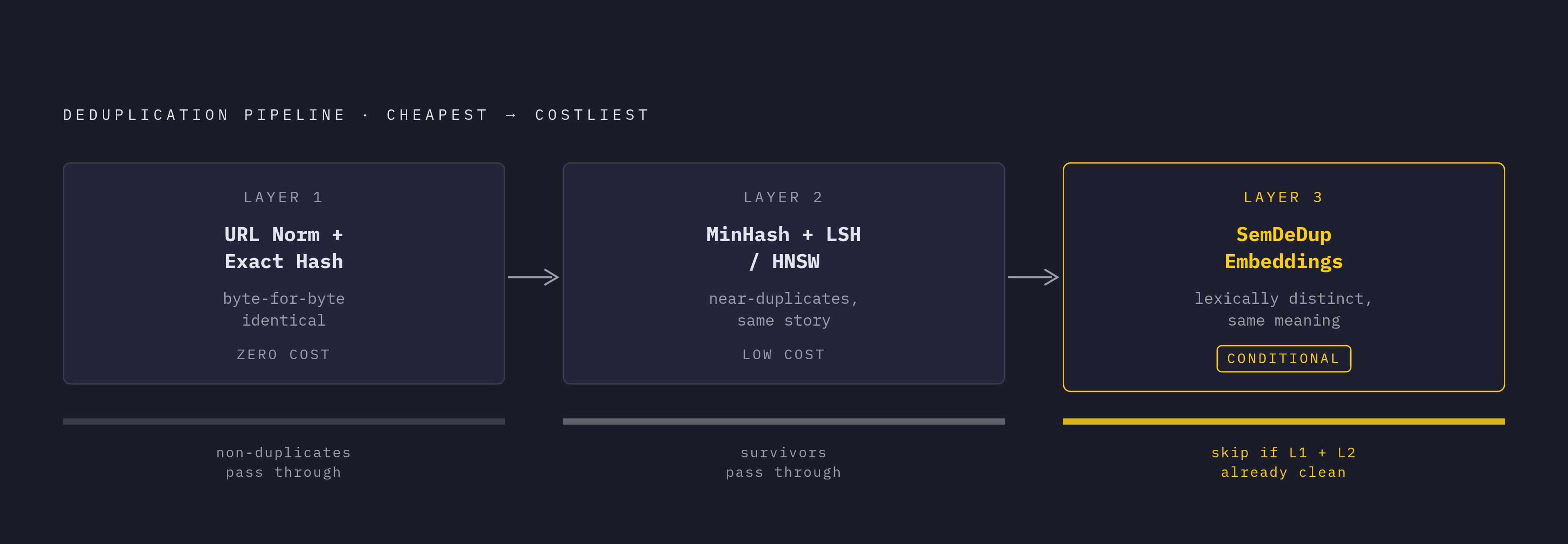
With URLs normalized and the three duplication types understood on their own terms, the pipeline methods must run in a specific order. The methods that are cheapest and most precise should run first, so that each later stage only has to work on whatever's left over, not on the full incoming stream.
Layer 1 is URL normalization followed by an exact hash gate. Normalize the URL, then compute a cryptographic hash of the extracted content, and drop or block anything whose hash already exists in the seen-set. This stage produces zero false positives and costs almost nothing to run, which makes it worth doing on every single document before anything more expensive touches it. The hash manifest, keyed by URL along with a last-fetched timestamp, becomes more than a dedup record. It becomes the backbone of incremental re-crawl logic, letting the system know which pages actually need to be re-fetched and which haven't changed.
Layer 2 applies MinHash and LSH to whatever survives Layer 1, catching the near-duplicates that exact hashing was never built to find. For corpora that never stop growing, like live-web crawls or agentic pipelines pulling fresh pages continuously, classic LSH setups scale poorly because the bucket structure has to keep getting rebuilt as new documents arrive. An incrementally updated HNSW index over the documents already admitted solves this differently: it retrieves a small, high-quality set of candidate neighbors for each new document as it comes in, rather than rebuilding global buckets from scratch.
Layer 3 runs semantic deduplication, but only on the candidates that already survived Layers 1 and 2. Running embedding comparison against the full incoming stream would be prohibitively expensive; running it against the reduced candidate set makes the cost tractable. This layer is where lexically distinct but informationally identical content gets caught, the syndicated summary of a press release, the reworded version of the same announcement. The clearest evidence that embedding-based dedup improves model quality comes from noisy corpora, and the case is less established on cleaner, more targeted data, so whether Layer 3 is worth running depends on the corpus. Treat it as conditional. Apply it when the corpus is noisy and retrieval precision is the thing being optimized for, and skip it when the first two layers already produce a clean enough result.
This layered pattern isn't a theoretical ideal. Blu-WERP documents multilevel deduplication as a core stage of its pipeline, and FineWeb, RefinedWeb, Dolma, and Nemotron-CC each document multi-stage deduplication as a standard pipeline component in their own right. The pattern recurs across independently built systems because the cost-ordering logic holds regardless of which team is implementing it. The constraint driving all of it is the same one raised earlier: every method has a specific failure boundary, and knowing where that boundary sits is what forces a layered design instead of one universal filter. That's especially true for crawl pipelines feeding LLM-driven systems, which are sensitive both to missing content and to redundant input; a wrong dedup choice at any layer degrades retrieval quality or wastes inference cost later on.
Granularity failures make this concrete. A fix shipped January 28, 2026 moved to per-page content hashing instead, restoring accurate page-level deduplication and cutting down on redundant ingestion during re-crawls. The fix didn't change which method was being used. It changed the unit the method was being applied to, which turned out to be the actual source of the failure.
How granularity changes what gets removed
Choosing a method is only half the decision. The unit that method operates on, whole document, subdocument region, single snapshot, or the full historical corpus, determines what survives and what gets thrown away, often just as much as the method choice itself.
Document-level deduplication removes an entire document once its similarity score crosses some threshold. That's the correct call when the whole document really is redundant, and the wrong call when two documents share only a navigation bar or a copyright notice while carrying genuinely different bodies of text. Models trained on data processed this way achieved the best overall performance among the settings the Hunyuan team evaluated, on both FineWeb-Edu and a code-containing web corpus.
Scope matters just as much as granularity within a document. Deduplicating globally, across every snapshot a crawler has ever collected, tends to favor content that shows up in the most recent crawls, because older snapshots are the last ones compared against everything else and get stripped down disproportionately. For a RAG pipeline grounded in live web data, the equivalent fix is scoping deduplication to a freshness window instead of collapsing it across the entire historical crawl state. Skipping that, the pipeline accumulates stale records that have technically survived deduplication but crowd out content that's actually current.
Dynamic content adds a separate wrinkle to all of this. The dedup logic never fires, and the index slowly fills up with near-identical copies of the same page, one for every time it happened to be fetched.
Why live-web pipelines need change detection coupled to deduplication
Everything above assumes a corpus that eventually holds still long enough to be deduplicated. Live-web pipelines don't get that luxury. Pages update, get rewritten, get taken down, and reappear with new content under the same URL, often within hours. A deduplication layer that only asks "have I seen this before?" without also asking "has this changed since I last saw it?" will end up doing one of two things wrong: it keeps re-ingesting a page that hasn't meaningfully changed, wasting compute and polluting the index with near-identical snapshots, or it treats a genuinely updated page as a duplicate of its old self and silently fails to pick up the update.
The hash manifest built in Layer 1, keyed by URL with a last-fetched timestamp, is what makes this coupling possible. It gives the pipeline a record of not just what content exists, but when it was last confirmed current, which is the foundation incremental re-crawl logic needs to decide what's worth fetching again. Scoping near-duplicate and semantic deduplication to a freshness window, rather than running it against the full historical crawl, keeps that same logic consistent at every layer of the stack: a page from six months ago shouldn't be allowed to suppress a page crawled this morning just because the two are similar enough to collapse together.
This is the layer where deduplication must behave like a living part of the system, keeping pace with a web that never stops changing underneath it. For teams building retrieval or agentic systems on top of live crawl data, that coupling between freshness and deduplication decides whether the system answers with this week's facts or confidently repeats something that stopped being true months ago.
Sources
- Scalable Frequency- and Length-Aware Subdocument Deduplication for Large Language Model Pretraining
- Blu-WERP (Web Extraction and Refinement Pipeline): A Scalable Pipeline for Preprocessing Large Language Model Datasets
- Web Scraping API Pricing: Plans from $0 | Context.dev
- LSHBloom: Internet-Scale Text Deduplication
- FOLD: Fuzzy Online Deduplication for Very Large Evolving Datasets via Approximate Nearest Neighbor Search
- URL normalization for de-duplication of web pages