Metadata Filtering to Reduce Retrieval Noise in RAG
Filtering retrieved documents by metadata slashes hallucination rates by half or more.

RAG systems don't fail because models are dumb; they fail because retrieval hands the model a messy pile of documents, and the model dutifully synthesizes an answer out of whatever's in that pile, good or bad. RAG is supposed to cut down on hallucination by grounding answers in real documents, and on average it does, by a wide margin. But the whole pipeline rests on one assumption that doesn't always hold: what the retriever surfaces, the model tends to trust.
That assumption breaks down in ways that show up in real numbers. Stanford Law School ran 200 legal research queries through leading RAG-powered legal tools in 2025 and found hallucination rates between 17% and 33%, including citations to cases that never existed, complete with plausible names, dates, and reasoning. A Korean financial RAG service running in production generated 2,265 responses; 960 got flagged as errors, and a detailed audit found that 51.6% of those flagged errors were genuine hallucinations, putting the estimated production hallucination rate around 21.9%. A 2025 survey published in MDPI puts domain hallucination rates at 10% to 20% in medical RAG and as high as 33% in legal tools.
Different domains, same root cause. Retrieval returns a noisy set of candidates, the model synthesizes across all of them without much discrimination, and whatever's wrong in that set has a good shot at ending up in the final answer. Bigger models and better prompts don't fix this, because the damage happens before generation even starts. The fix belongs upstream, at retrieval, and metadata filtering is the most direct tool available for narrowing what the model ever sees.
What metadata filtering actually does to the retrieval candidate set
Metadata is the structured stuff attached to a document chunk that sits outside the embedding: source URL, publication date, document type, domain, author, topic tag. Vector similarity search measures how close two pieces of text are in meaning. It has no opinion on whether a document is current, credible, or even the right kind of document for the question. Metadata filters are how you bring those judgments into the pipeline, because embeddings can't make them on their own.
Filtering can happen at three points, and each shrinks the candidate set differently.
Pre-filtering applies attribute constraints before the vector search even runs. Only chunks that pass the filter get compared for similarity at all, which cuts noise and speeds things up in the same move. In-query filtering runs the metadata constraint and the similarity ranking together, in one pass; major vector databases support this natively now. Post-retrieval filtering comes after the fact: you pull the top results, then apply rule-based or model-scored checks to catch anything that matched semantically but shouldn't have made the cut, like a chunk about the right topic from the wrong domain entirely.
In practice, four metadata fields do most of the work: date, source or domain, document type, and topic category. Date lets you enforce a recency window and exclude anything stale. Source lets you restrict retrieval to origins you actually trust and block low-credibility material outright. Document type keeps technical documentation separate from marketing copy, or transcripts separate from formal reports, so the retriever doesn't confuse tone for substance. Topic category gives a coarse signal that backs up whatever the embedding is already trying to capture.
Metadata filtering works alongside semantic search rather than in place of it: it defines the space semantic search is allowed to operate in. A query about a 2024 regulatory change should never surface a 2019 white paper just because the two share vocabulary. Similarity math won't stop that on its own. A date filter will, every time.
The measured precision gains when metadata filters are applied
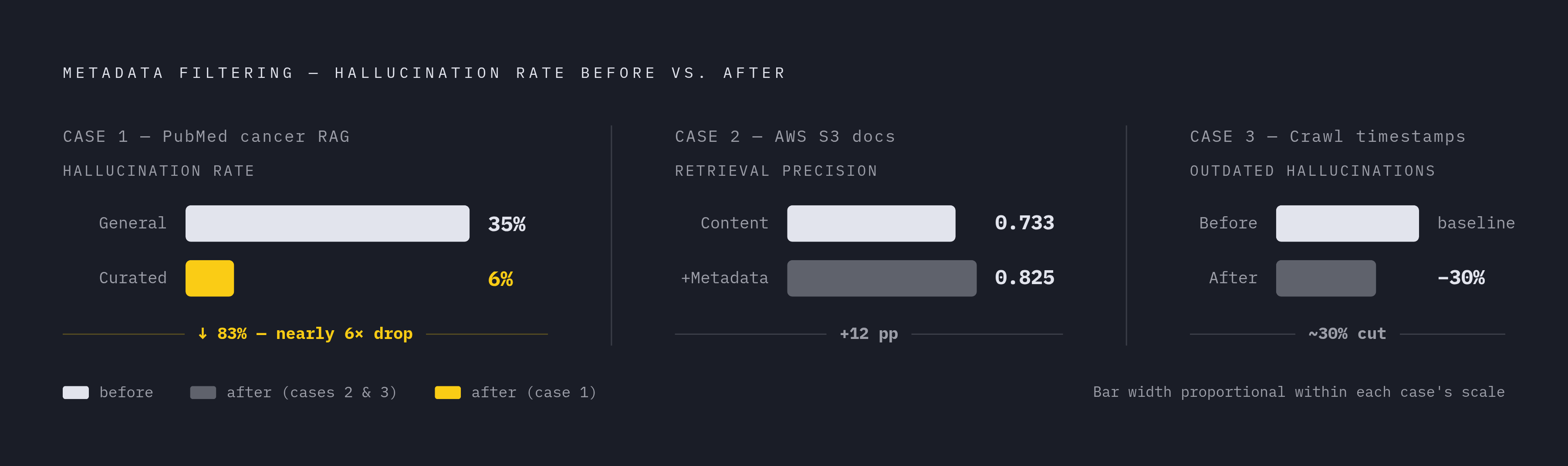
On enterprise datasets built from AWS S3 documentation, metadata-enriched retrieval hit a precision of 0.825, compared with 0.733 for content-only retrieval, a gain of roughly 12 percentage points.
Multi-Meta-RAG, a 2024 approach from Poliakov and colleagues, uses an LLM to pull symbolic filters straight out of the query, then applies those filters before embedding search ever runs. On multi-hop questions, the kind that need evidence stitched together across several documents, GPT-4 accuracy moved from a baseline of 0.56 up to 0.606 once metadata filtering was in the loop. That's a modest jump on paper, but it lands exactly where noise does the most damage: cases where the model has to assemble a chain of facts, and one bad link breaks the whole chain.
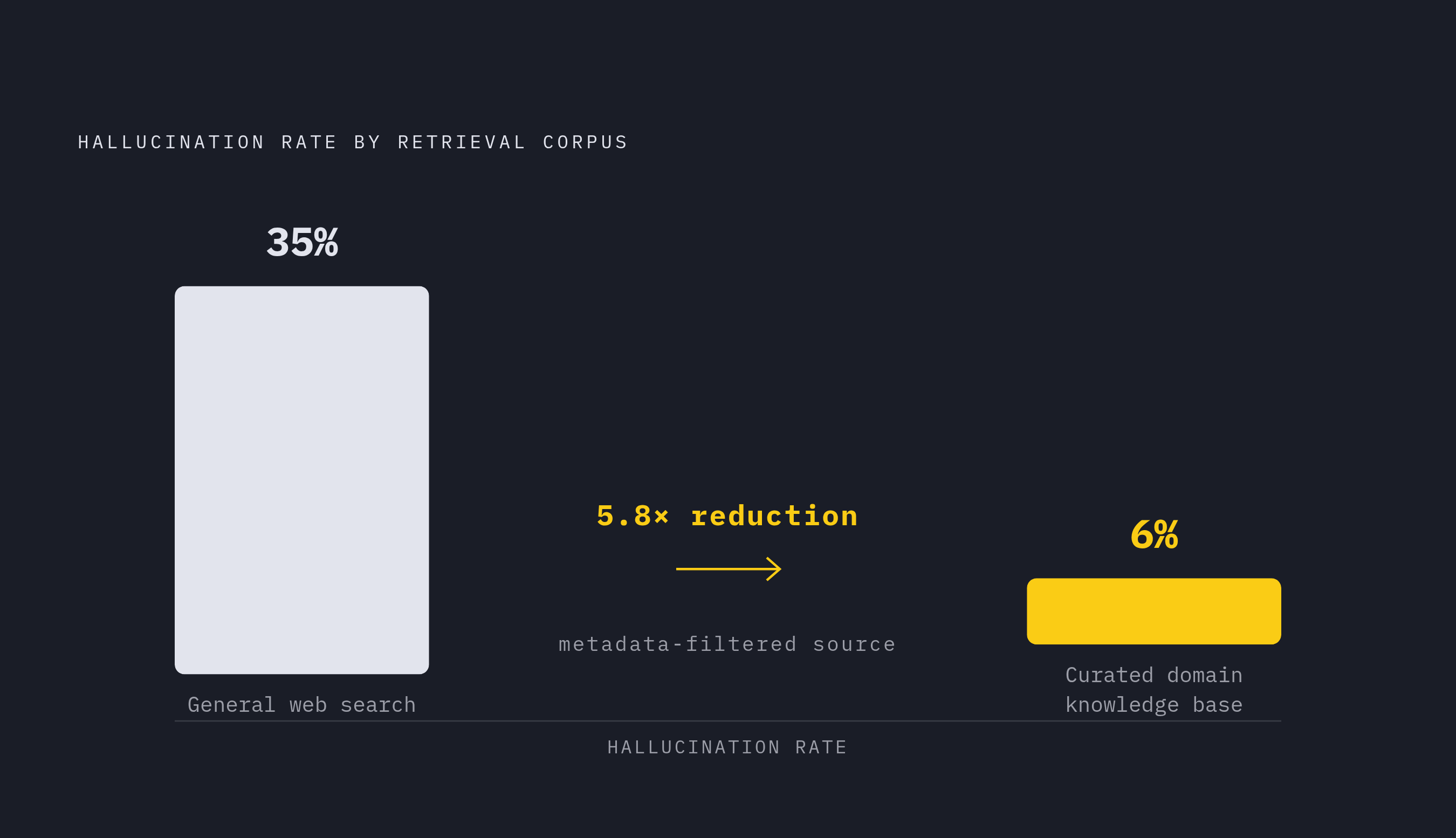
The clearest evidence, though, comes from a PubMed study on RAG chatbots answering cancer-related questions. Pulling from general web search as the retrieval corpus produced a 35% hallucination rate. Constraining retrieval to a curated, domain-specific knowledge base dropped that to 6%. Nearly sixfold. That's metadata filtering in its rawest form: the source field alone decides which corpus is even eligible to answer from, and the downstream effect on hallucination is enormous.
SchemaRAG applies the same logic to structured extraction tasks, pruning which output fields are even eligible given a document's metadata, and reports up to an 8.8% gain in micro-F1, alongside a 47% cut in latency and a 48% cut in token cost. Put these together and a pattern emerges: precision goes up, latency goes down, cost goes down, because filtering removes work from every step downstream, not just from retrieval itself. What's still thin is multi-hop evaluation. Most benchmarks test single-hop retrieval, where the payoff from filtering is smaller and easier to measure. Multi-hop is where metadata filtering should matter most, and it's also the hardest case to build and test properly.
How structured metadata gets onto documents in the first place
Metadata comes from two places: it's either pulled directly from the document, or it's inferred by a model looking at the content.
Explicit extraction happens at crawl or ingest time. Source URL and domain come straight from the crawler or the API call that fetched the page. Publication date gets pulled from HTML metadata, Open Graph tags, bylines, or structured data like JSON-LD. Document type gets guessed from URL patterns, MIME type, or structural cues on the page. None of this is expensive if the ingestion pipeline is built to capture it up front. It gets expensive fast if a team tries to reconstruct it after the fact, once the raw content has already been indexed without it.
Some metadata can't be read off the page at all. Topic category, technical domain, entity tags, quality signals: these need an actual pass over the content, usually by a model. Multi-Meta-RAG runs an LLM over raw documents before indexing to pull out exactly this kind of symbolic metadata. It adds time at ingest, but it pays for itself on every query that follows. Verification scores and hallucination-detection signals can be stored the same way, as metadata fields that later get used as filters.
The better approach is schema-driven ingestion: decide on a fixed set of typed metadata fields before ingest starts, so every chunk carries the same structure. Without that, you end up with tag soup, where half the documents have a date field and half don't, and filtering becomes unreliable. This mirrors a broader rule in data pipelines: impose structure at the point of entry, don't try to infer it later at query time.
None of this works if the input is a mess. Raw HTML dumps full of navigation bars, ads, and boilerplate produce poor metadata, because the model doing the tagging is wasting attention on junk. Converting content to clean text before running any LLM-based tagging step improves the accuracy of the tags and cuts the token cost of getting them.
Why stale documents are a metadata problem, not just a freshness problem
Every model has a training cutoff, and performance on anything past that cutoff drops off sharply. On one benchmark, baseline accuracy on post-cutoff events sat at 0.2022; adding web-sourced retrieval widened the gap between configurations with and without that retrieval from 16.3% on a standard validation set to 44.16% on a set built entirely from post-cutoff material. Retrieval is carrying a recency burden the model itself simply can't.
Bolting on live web retrieval, though, doesn't solve staleness by itself; it just relocates the problem. If retrieved documents don't carry a reliable timestamp, the retriever has no way to tell a 2024 regulatory update apart from a 2019 overview that happens to rank high on semantic similarity. The document itself hasn't changed; what's missing is the metadata that would let the system know it's old.
Staleness, in other words, is a tagging failure before it's a freshness failure. A document with no timestamp can't be filtered by recency, full stop. A vector store with no re-indexing schedule quietly accumulates outdated chunks that look, at retrieval time, exactly like fresh ones. Keeping the crawl-to-index pipeline continuously updated cuts outdated hallucinations by roughly 30%, according to published figures, but only if ingestion actually captures timestamps and passes them through to the filter layer. Skip that step and the continuous crawling buys you nothing.
Three filter patterns handle this in practice. A hard recency window rejects anything older than some threshold for queries where currency genuinely matters. A soft decay approach down-weights older chunks by age without excluding them outright, useful when older material still has some value. Query-time date detection parses phrases like "as of last month" or "current policy" straight out of the user's question and sets the recency filter dynamically. Any domain where facts actually shift, like product docs, regulatory guidance, or financial data, makes a static vector store architecturally unfit for the job unless it's paired with a live crawl schedule and metadata that gets refreshed on every pass.
Applying filters at query time: where the constraint logic actually lives
Filtering happens at three points, and the tradeoffs are different at each.
Pre-filtering, applied before the vector search runs, is the fastest option because ineligible chunks get thrown out before any similarity math happens. It needs a vector database that indexes metadata properly, and it carries a real risk: set the constraints too tight, and you filter out documents that should have been in play.
Hybrid filtering runs the metadata constraint and the similarity search together, in a single query. Most major vector databases support this now: vendor-specific filter interfaces. One query goes in, one already-constrained result set comes out.
Post-retrieval filtering is the most flexible of the three. It applies scoring, whether rule-based or model-driven, to the top results before they ever reach generation. It's also the slowest, and it's best reserved for soft constraints that don't reduce cleanly to a simple attribute check.
These filters can't stay static, because a query's intent changes what the filter needs to be. The system has to read the query itself and pull out implicit filter signals: a date reference, a named domain, an expectation about document type. Multi-Meta-RAG does exactly this, using an LLM to extract symbolic filters from the query before retrieval starts, so the same model call that understands the question also generates the filter parameters. That's what makes the filter layer adaptive, capable of adjusting to each query rather than applying one fixed rule set across the board.
Evaluation tooling for this exact pattern is only now catching up to the practice.
A few mistakes show up constantly in real implementations. Teams filter on a metadata field that was never populated at ingest, so the filter silently returns nothing, or everything. Teams hardcode filter values instead of deriving them from the query, so the filter works for the one case it was built for and misfires on everything else. And teams treat post-filter re-ranking as a substitute for pre-filter scoping, which is backwards: re-ranking a large noisy set costs more and works worse than filtering down to a small clean set first. Hybrid keyword-plus-semantic search, on published figures, improves grounding accuracy by around 20%; pair it with metadata pre-filtering and scoped candidate sets and both the recall benefit and the precision benefit show up together.
Advanced filtering approaches for pipelines that need more than attribute predicates
Metadata filtering is the baseline. It's cheap, well-supported, and it's what nearly every production RAG pipeline should have running before anything fancier gets layered on. But it's not the ceiling. There's a continuum running from simple attribute filters, to learned filters, to systems where the model itself adjudicates relevance, and a few approaches sit further along that line.
Some approaches address noise inside the attention mechanism directly, at a later stage than cleaning the candidate set before the model ever sees it. Other approaches feed a metadata-derived credibility signal straight into the model's attention rather than into a pre-filter. Still other approaches train the model to critique its own retrieved passages and decide, on the fly, whether to use them at all. Filtering becomes a learned behavior instead of a rule enforced from outside.
All three are chasing the same target metadata filtering chases: less noise reaching generation. They just do it at a steeper cost, in compute and in engineering complexity, and they belong on top of metadata filtering, alongside it rather than as a replacement for it. Skipping the cheap, well-understood filter layer to jump straight to a learned one is how teams end up debugging a hallucination that a simple date field would have prevented in the first place.