Multi-Tenant RAG Index Isolation Patterns
Separate indexes enforce isolation at the storage layer, not the prompt.
Multi-tenant RAG isolation is a data security problem wearing a retrieval-accuracy costume. Most teams building RAG systems spend their time on chunking strategy and embedding model choice, and almost none of it on who's allowed to see what once the data lands in a shared vector store. That's backwards, and the gap shows up the moment a second customer joins the platform.
Standard RAG tutorials walk through chunk size, overlap, embedding dimensions, rerankers. Authorization barely gets a footnote. The naive pattern that fills that gap looks something like this: dump every tenant's documents into one index, tag each chunk with a tenant_id, and tell the system prompt to "only answer using data for tenant X." That's not an isolation boundary. That's a suggestion, and suggestions don't hold up against a malformed query, a prompt injection, or a developer who forgot the filter on one code path out of forty.
The stakes are bigger than one embarrassing support ticket leaking across accounts. A vector store that pulls in fragmented data from dozens of SaaS tools, across every tenant, without hard isolation, is close to the most efficient exfiltration engine you could design on purpose. Per Proofpoint's 2025 Data Security Landscape report, 46% of organizations already struggle with cloud and SaaS data sprawl, and 31% say redundant or obsolete data sitting around poses a real risk. The average midsize company runs over 200 SaaS apps, each with its own auth model, and every one of them is a potential ingestion source. Ransomware aimed at SaaS data succeeds in encrypting it 52% of the time, the highest success rate of any environment tracked. Centralize all of that into one pool with no walls between tenants, and the blast radius of a single breach stops being one customer's problem and becomes everyone's.
The fix is a boundary enforced at the vector database layer, not the prompt layer. And there are a small number of recognized ways to draw that boundary.
The three isolation patterns and where each one draws the boundary
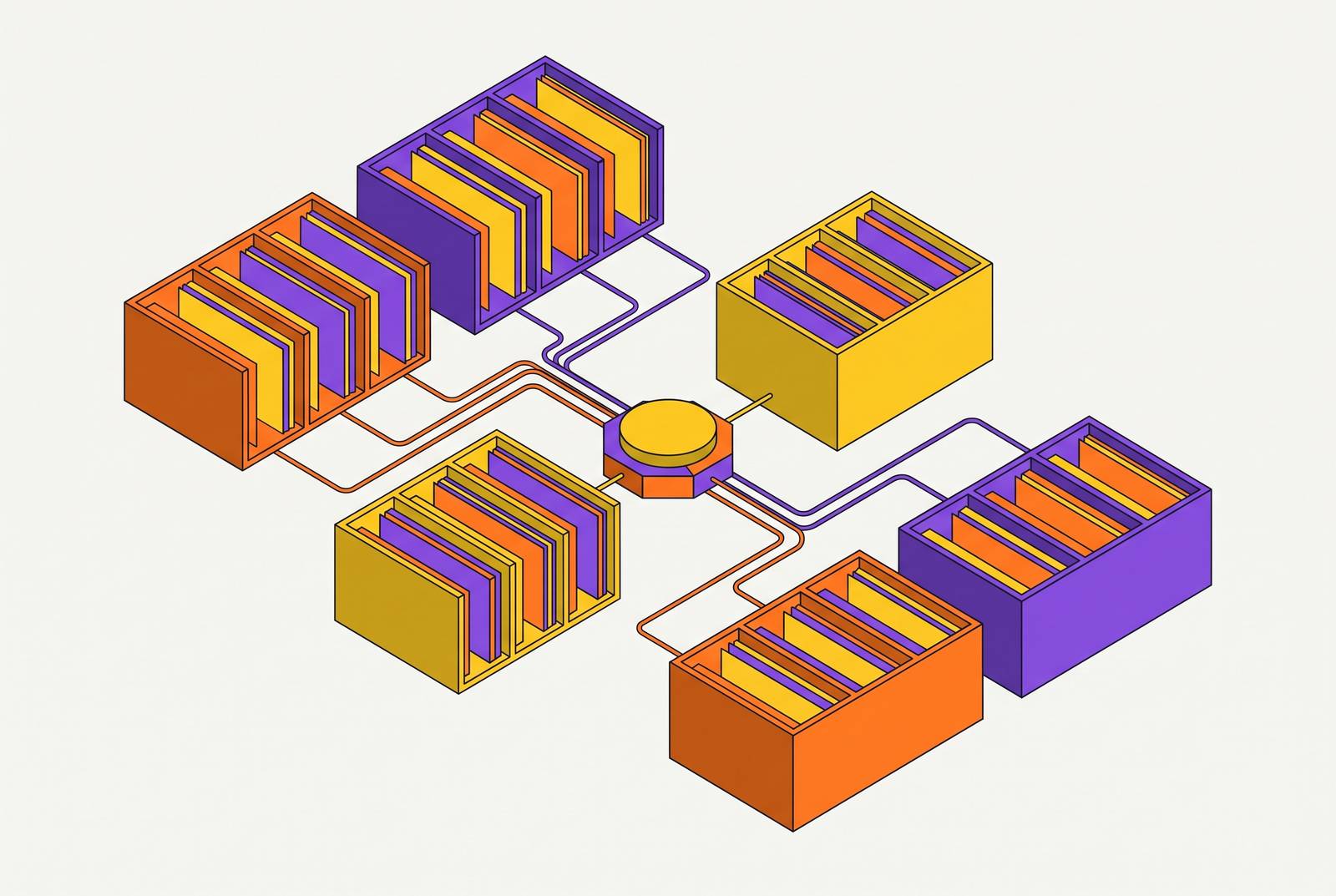
Everything written about multi-tenant RAG architecture eventually collapses into three patterns: Silo, Pool, and Bridge.
Silo (index-per-tenant). Each tenant gets its own dedicated index, collection, or knowledge base. Full physical separation. There's no code path where a missing filter accidentally exposes someone else's data, because the other tenant's data isn't in the same index to begin with. The storage layer itself is the enforcement point, not application logic. This also means per-tenant encryption keys through a KMS, per-tenant retention policies, and a clean offboarding story: a customer churns, you drop their index, done. Auditable, simple, final.
Pool (namespace isolation with metadata filtering). All tenants share one index. Separation happens through logical namespaces and metadata tags. The enforcement point moves to the query layer: every single retrieval call has to combine semantic search with a tenant_id filter applied at the database level, not bolted on in the prompt. Onboarding a new tenant is one API call. Offboarding deletes a namespace instead of tearing down infrastructure. The catch: the isolation guarantee is only as strong as the discipline of whoever wrote the query code, every time, with no exceptions.
Bridge (hybrid). Shared orchestration and often a shared generator model, but selective isolation underneath. Large or regulated tenants get their own dedicated index. Smaller tenants share a pooled one. Shared reference material, like public product documentation, lives in a common collection with no customer identifier attached at all, since it's meant to be visible to everyone. Bridge is a real architecture, not a compromise for people who couldn't decide, but it comes with a cost: two enforcement models running side by side, and both need separate audits.
The four planes where isolation must hold (and where each pattern fails)
Isolation isn't one property. It's four, and they don't all live in the same place.
Data plane. Where embeddings and chunks actually sit at rest. Encryption boundaries belong here. Per-tenant keys mean a compromised key only exposes one tenant, not the whole index.
Retrieval plane. Where the vector search runs. Filters applied here have to be deterministic, meaning the same query with the same tenant context always returns the same boundary, no exceptions. This is where Pool's entire enforcement model lives, and it's the plane most exposed to a simple application bug.
Generation plane. Where the LLM turns retrieved chunks into an answer. This is the least trustworthy place to enforce anything. LLMs are non-deterministic by design and vulnerable to prompt injection, so building your security model around "the model won't say the wrong thing" is building it on sand.
Run the three patterns against these planes and the failure modes get specific fast. Silo holds at the data plane by construction, since separate indices mean separate storage, full stop. Its failure mode is operational: you hit index count limits before you hit customer count, and HNSW graphs sitting in RAM for tenants who log in twice a year waste real memory.
Pool's entire security model rests on the retrieval plane. When it fails, it fails completely: one query missing the tenant_id filter exposes the whole shared index, not just a partial slice. This isn't hypothetical. The Asana AI connector incident, where a flawed tenant-isolation check in the MCP server exposed sensitive data across organizations, is exactly this failure class playing out in production.
Bridge inherits both failure modes at once, since it's running both enforcement models simultaneously. Whoever owns the security review has to audit two systems, not one, and confirm neither has drifted.
No pattern makes the four-plane problem go away. They just decide which planes get protected automatically and which ones depend on a developer remembering to do their job correctly, every single time.
How compliance requirements (GDPR, HIPAA, PCI-DSS) map onto pattern choice
Embedding a customer's documents into a cloud vector index is not a neutral technical operation. Under GDPR, it's a data processing activity, and that means a legal basis, data residency rules, and explicit contractual permission before a single vector gets written. CCPA covers similar ground on personal information but doesn't carry the same legal-basis or residency requirements, so a compliance model built for one won't automatically satisfy the other.
Here's the part teams miss: sending ticket text to a third-party embedding API is itself a data transfer. The embedding call is the regulated event, not just the storage that follows it. A support knowledge base RAG project can stall in procurement the moment a customer's Data Processing Agreement requires data to stay inside the EEA, or an auditor asks a simple question nobody prepared for: where does the data physically go during processing?
This is why healthcare, financial services, and manufacturing keep landing on the same architecture, on-premise deployment, embeddings computed and stored locally, nothing regulated routed out to a third-party API. The regulation changes name (GDPR, HIPAA, PCI-DSS) but the engineering answer stays identical.
Mapped against the isolation patterns:
- Silo gives the strongest compliance story. Per-tenant keys, per-tenant residency enforcement, and a GDPR right-to-erasure request that resolves to one clean index drop. This is the natural fit for healthcare, financial services, and any enterprise tenant with a custom DPA.
- Pool works fine for lower-sensitivity tenants, provided metadata filtering is implemented correctly and the logs prove it. Proving per-tenant data residency in a shared index is a harder conversation with an auditor.
- Bridge lets regulated tenants sit in their own silo while everyone else shares the pool, but the compliance documentation has to be written and maintained separately for each tier. Nobody gets to wave at "the architecture" and call it covered.
None of this is a reason to skip RAG for support use cases. Companies that deploy semantic search across their support knowledge base report substantially faster resolution times with semantic retrieval in place. The performance case is real. The architecture just has to keep regulated data where it's allowed to sit.
The real cost of the Silo pattern at scale, and why Pool is not always the cheap answer
Silo's cost problem isn't abstract, it's structural. HNSW graphs need to stay in RAM for retrieval to stay fast, and running hundreds of separate indices means paying to keep memory reserved for tenants who query twice a week. At real scale, most platforms hit their vector database's index count limit before they hit any meaningful customer count ceiling. That's not a budget conversation. That's a hard technical wall.
Onboarding friction compounds it. Silo needs a provisioning step, however automated, for every new tenant. Pool needs one API call. As tenant count climbs into the hundreds or thousands, that operational gap starts to matter more than the per-tenant compute cost.
Pool's savings are real, but they come with a condition attached: query load needs to be reasonably even across tenants. Drop one high-volume tenant into a shared index and their traffic becomes a noisy neighbor, slowing retrieval for every other tenant sharing that index. Pool's efficiency assumes a distribution that doesn't always hold.
A few levers apply regardless of which pattern gets chosen:
- Quantization can significantly cut vector storage requirements with minimal accuracy loss. Well-quantized 8-bit embeddings frequently outperform full-precision embeddings from a weaker model, so this isn't purely a cost trade, it can be a quality win too.
- Quantization only touches the storage side. Embedding cost still scales linearly with document volume, since every chunk still has to be encoded once regardless of how compact it ends up after that.
- Bridge architectures can help address the noisy-neighbor problem by giving certain tenants dedicated indices while leaving others in the shared pool.
The practical rule of thumb: Silo earns its cost for a smaller number of high-value, high-compliance tenants. Pool earns its cost for a large number of lower-sensitivity tenants with predictable, evenly spread load. Bridge is what most SaaS platforms actually run in production, because real customer bases are never one or the other.
Ingestion pipeline design: where cross-tenant contamination actually originates
An isolation pattern is only as good as the pipeline feeding it. A perfectly designed Silo can be silently violated by an ingestion bug that files one tenant's documents into another tenant's namespace, and nobody notices until a query surfaces the wrong customer's data in an answer.
The root cause is almost always source diversity. Ingestion pipelines are pulling from Salesforce, Confluence, Jira, Zendesk, and often dozens more APIs beyond those, and each one comes with its own pagination logic, its own auth scheme, its own permission model. Every one of those integrations needs custom connector code, and that connector code is exactly where tenant_id assignment bugs hide. Nobody notices a mislabeled document at ingestion time. Someone notices it three weeks later, in an answer that shouldn't exist.
PII sanitization has to happen before embedding, not after. Support tickets are full of names, email addresses, account numbers, usage details. Once that text gets embedded, the PII is baked into the vector representation itself, and stripping it out later doesn't undo that.
A concrete schema discipline, informed by multi-tenant RAG implementation guidance, keeps this disciplined:
customer_idas a mandatory field on every tenant-scoped chunk, with every query required to combine semantic search with this filter, no exceptions.source_typedistinguishing "ticket" from "knowledge_base," since shared KB content intentionally carries nocustomer_idat all.- Supporting fields like
product_line,ticket_status, andcreated_datefor filtering by category or time, without touching the isolation boundary itself.
There's a second, quieter failure mode: state drift. A document gets updated in the source system, but the embedding sitting in the vector index still reflects the old version. Without event-driven re-indexing, a query can retrieve a chunk that's confidently, fluently wrong, because it's answering from a stale snapshot nobody flagged. Streaming CDC-connected ingestion keeps embeddings current within seconds of a source change, and the cost scales with how much changed rather than the size of the whole corpus. Nightly batch re-index jobs, the old default, are turning into a real liability heading into 2026, since a full day's staleness window is a long time for support content to be wrong.
Audit logging at ingestion, recording which source fed which tenant and which chunks got written on each run, is the evidence an enterprise security review will ask for by name. Skip it, and there's no way to answer "how do you know contamination didn't happen" with anything other than a shrug.
Query-time enforcement: JWT-scoped retrieval, RBAC, and what "secure by default" means in practice
Silo's query-time enforcement is mostly implicit: routing a query to the right tenant's index is the enforcement. Test the router, not the query logic, since a misconfigured router sending traffic to the wrong index is the actual failure mode worth chasing down.
Pool has no such shortcut. Enforcement is explicit and mandatory on every single call, and any code path that constructs a vector search without the namespace filter attached exposes the entire shared index to whoever sent that query. Deterministic isolation using namespaces combined with JWTs is a strong approach worth building toward: the token itself carries the tenant boundary, so the boundary doesn't depend on a developer remembering to attach a filter by hand.
Tenant isolation is only half the access control story, though. Inside a single tenant, not everyone should see everything. A sales rep shouldn't be able to retrieve an executive's board deck just because they both work at the same company and share the same tenant boundary. Document-level RBAC has to sit on top of tenant isolation, and it has to be enforced at retrieval time, before generation, not after the fact by hoping the model declines to repeat something sensitive.
"Secure by default" has a specific, testable meaning here: if the tenant_id filter is missing from a query, the query should fail outright or return nothing, never fall back to searching the full index. That behavior needs to be enforced by the vector database itself, not left as a convention the application layer is supposed to remember.
Scope control matters just as much. Plenty of systems run one large index with no mechanism to restrict a query to a specific trusted source, like a customer's own ticket history versus the general knowledge base. Without that scoping, there's no clean way to trace where an answer's information actually came from, and that makes the whole system harder to defend in front of a governance review.
None of this holds unless it's tested the way an attacker would test it. Cross-tenant prompt injection attempts, queries with the filter deliberately stripped out, namespace boundary probes: these belong in CI/CD as automated checks, run on every deploy, not saved for an annual manual security review.
How live web data enters multi-tenant RAG pipelines and why it requires its own isolation treatment
Most multi-tenant RAG systems end up blending two very different kinds of content: private tenant data, like support tickets and internal docs, and live web content, like competitor pages or public documentation pulled in from the open internet. Each has its own ingestion path, and each ages differently.
Web content isn't tenant-specific by nature, but it still needs a scope boundary. A query meant to search only a customer's own ticket history shouldn't quietly expand to include a public web crawl unless that expansion was configured on purpose. Isolation isn't just about keeping tenants apart from each other. It's also about keeping public and private content from blending in ways nobody explicitly asked for.
Freshness is the adjacent problem that isolation work tends to expose. A chunk pulled from a web page might have been accurate the day it was indexed and wrong by the time someone queries it, because the source page changed and the index didn't. The vector store holds a snapshot, not a live view, and the model generating an answer from that snapshot has no way of knowing the page underneath it has already moved on.