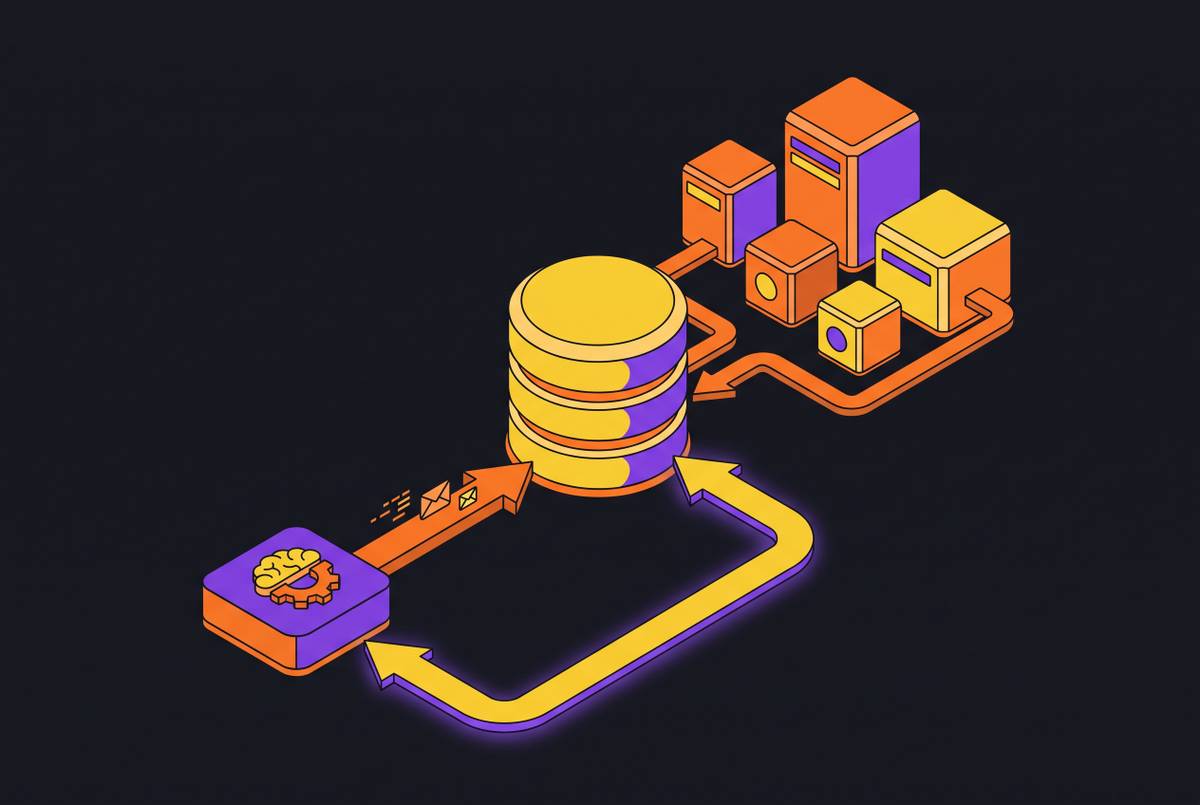
Structured Web Data Pipelines for Autonomous AI Agent Loops
Autonomous AI agents need fresh, validated web data in their decision loop, not stale HTML noise.
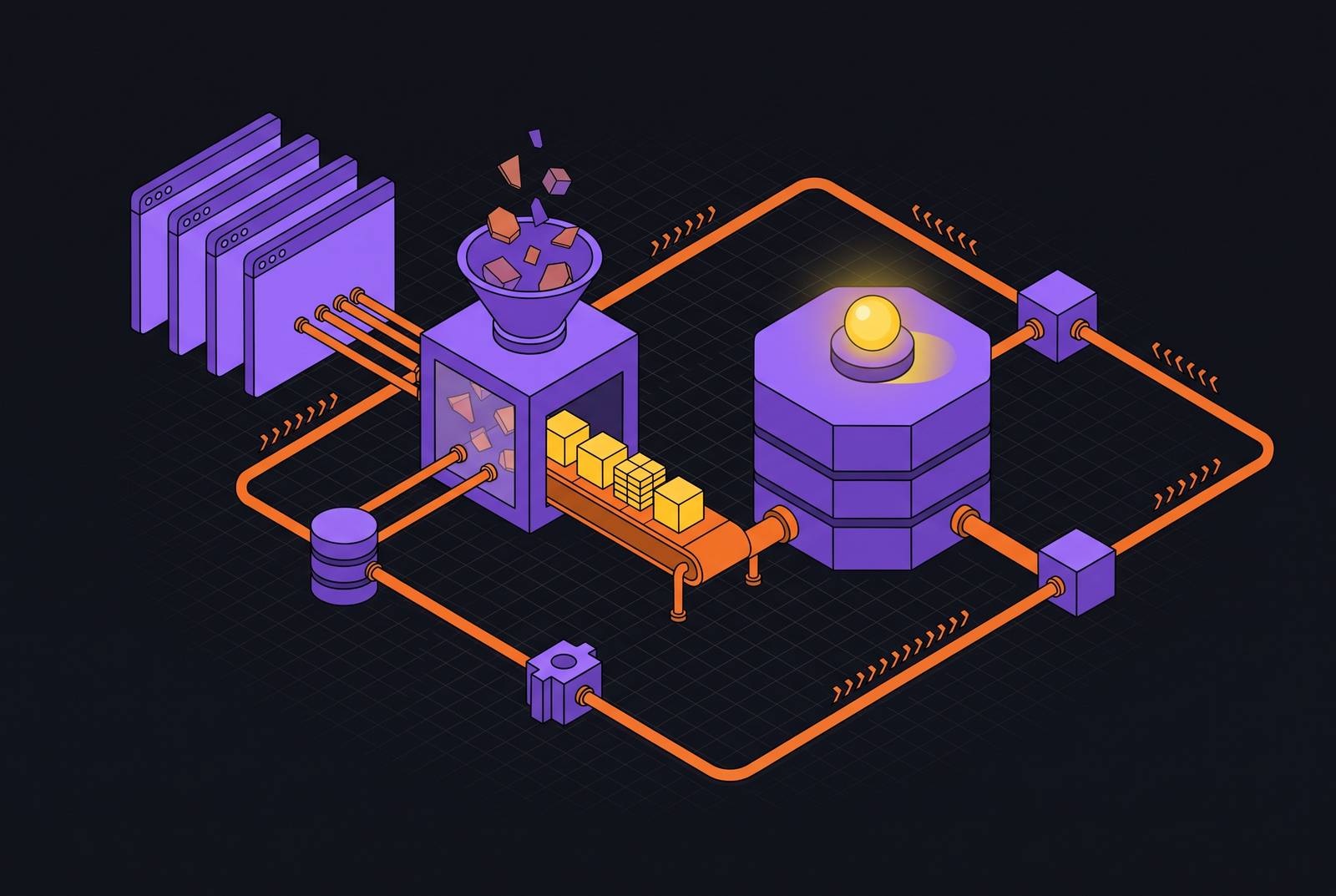
A web scraping API for AI agents and LLM pipelines should return clean Markdown or validated JSON, with explicit control over freshness. Structured web data pipelines keep autonomous loops reliable when discovery, extraction, schema enforcement, and delivery are built into the architecture from the start. Better reasoning cannot repair stale or malformed input.
Why autonomous agent loops stall without a structured data pipeline
An agent checks a product price, receives yesterday’s value from a warehouse, and makes its next decision as though that value were live. The reasoning can be sound while the answer is wrong. A scheduled batch update gives the agent a frozen snapshot, even if the page changed hours or days ago. The failure starts before the model reasons.
Raw HTML makes that problem worse with scripts, navigation, and boilerplate that use up tokens without giving the model evidence it can use. Inference costs go up as the model spends its attention on noise. Malformed fields add errors that carry through to later decisions. These failures share a cause, which is treating web ingestion as an afterthought rather than designing it for the loop that depends on it.
The four layers every production web data pipeline must own
A production web data pipeline has four sequential concerns, namely discovery, extraction, schema enforcement, and delivery. Discovery identifies the URLs worth fetching and the order in which to fetch them. Extraction turns their content into usable Markdown or JSON. Schema enforcement checks whether the resulting records meet the agent’s data contract. Delivery supplies those records when the relevant agent step needs them.
Without discovery, a pipeline can crawl the same pages over and over and miss updates that matter. Without enforcement, successful extraction can still deliver unusable records. If delivery is late, even correct records can arrive after the decision that needs them. Kafka and message queues move data that already exists, but something upstream must still retrieve the live page.
Discovery — choosing the right data source before writing a line of extraction code
The cleanest source should determine the extraction method. Official APIs or XHR JSON endpoints come first because they offer repeatable, stable access without rendering costs. Embedded JSON comes next, including __NEXT_DATA__, JSON-LD, and hydration blobs already present in page source. These sources expose structure that a browser or model would otherwise have to recover.
A managed browser is appropriate when login, interaction, or dynamic content leaves no cleaner path. Raw HTML parsing is the last resort because site redesigns can break its assumptions. Cleaner sources mean less machinery to maintain. Using a browser agent or LLM before checking those sources uses compute and adds upkeep that may not be needed.
Sitemap-based ingestion defines crawl scope before page fetching begins, while parallel chunking distributes discrete work packets across workers. Backoff on rate-limit responses keeps that process running without someone having to step in all the time. The practical rule is to use an agent to inspect and choose the source, then implement recurring extraction as deterministic code with logs, retries, and tests.
Extraction — why schema-driven output is the correct default for agent pipelines
Schema-driven extraction sets out which fields and types to return and what they mean before it processes a page. A selector-based scraper instead encodes assumptions about where those fields sit in the DOM. When a UI team changes a class name, a selector can stop finding its target while the pipeline continues returning empty or malformed records. The process runs, but its output has failed.
Defining what to extract makes the schema the interface and the parsing method an implementation detail. That does not require an LLM on every page. Clean JSON sources can support deterministic extraction, while intelligent extraction is useful when data does not map neatly to CSS classes. Product specifications buried in descriptions, review summaries, and conditional multi-step pages are examples where agents can outperform traditional scrapers.
Block rates and inference latency make it a poor default for high-volume recurring jobs. LLM extraction has a narrower role in one-off cleanup, small pages, screenshots, and PDFs, rather than unverified production data or financial facts. The production pattern remains agent-led discovery followed by deterministic extraction for throughput.
Cairo University’s February 2026 paper showed that a model well under a billion parameters could reach strong extraction accuracy when paired with intelligent DOM pruning. Schema-driven extraction can thus work without a costly frontier model. Output format is a separate source of cost. Clean Markdown preserves heading hierarchy for text consumption, while JSON supplies fields matching the defined schema. Returning raw HTML adds token overhead and retrieval noise each time the data is used downstream.
Schema enforcement — making extracted data a contract the agent can depend on
Requesting a schema is not the same as enforcing it. An empty field or mistyped value may arrive without an extraction error, leaving the agent to treat it as valid data. In an autonomous loop, that flaw can propagate through actions before a person notices. Validation belongs between extraction and agent consumption.
A field declared as a number must arrive as a number. Missing required fields must fail validation and trigger a retry or alert. Field descriptions also need to explain meaning, so the extraction engine knows what content belongs there and engineers can understand the contract. This boundary becomes especially useful with MCP-compatible tools. An agent that gets validated, typed JSON through MCP has a defined data interface, but raw HTML gives it no such contract.
Delivery — getting live, validated data to the agent at the moment it reasons
Delivery forces a choice between freshness, latency, and cost. Pre-indexed RAG retrieves quickly, but its freshest knowledge dates to the last indexing run. Prices, library versions, CVEs, and regulations can change faster than that cadence. An agent waiting on a batch refresh cannot close that gap on its own.
Web RAG fetches live data for each query, which adds latency and cost every time the agent needs evidence. Browsing agents go further with multi-step, interactive navigation and give the most faithful view of complex, stateful pages. They also impose the highest latency and cost. That makes browsing a better fit for specific tasks than for moving data through the pipeline as a whole. A per-request freshness parameter such as maxAgeMs makes the live-versus-cached trade-off explicit, covering both “must be live” and “yesterday is fine” without separate pipeline paths.
Freshness is useless if the fetch never succeeds. Standard headless browsers expose both browser fingerprints and behavioral signals, and LLM-driven sessions are not inherently less detectable. Direct navigation, irregular timing, and missing scroll events can make them more detectable than human sessions. Managed infrastructure takes on proxy rotation, CAPTCHA handling, and fingerprint management because this work consumes engineering time without distinguishing the product. Off-loading it to an API is an architectural decision.
MCP provides a common tool-invocation interface for requesting a page, extracting structured data, or looking up brand information without custom integration code for each action. The November 2025 MCP specification revision added OAuth Client ID Metadata Documents and incremental scope consent, building on the OAuth 2.1 framework introduced in March 2025. It also added an experimental Tasks abstraction for long-running operations. These changes support more auditable enterprise integrations. Pipelines built around a shared protocol are more composable than separate custom connections.
Website monitoring as a pipeline event, not a human notification
On-demand fetching does not cover every freshness requirement. A retrieval index also needs a way to learn that its source changed without waiting for the next agent query. An email or dashboard alert leaves a person responsible for reading it, judging relevance, and initiating another fetch. That breaks the autonomous chain at the handoff. A webhook with a structured JSON payload instead gives a downstream system an event it can act on immediately.
The detection method determines how useful that event is. Hash diff is the fastest and lowest-cost method, but byte-level changes from timestamps, ads, and rotating testimonials create noise. DOM element diff narrows detection to selected page regions at the cost of setup work per page. Text/Markdown diff compares readable content rather than markup, aligning the comparison with what the model consumes. Visual diff catches layout and design changes that text comparisons miss, so it can help with brand monitoring.
Semantic/AI diff filters changes against natural-language instructions before firing an event. A monitor can watch a competitor’s site for newly announced products while ignoring timestamps and minor layout updates. The resulting event is already screened for relevance. This connects monitoring directly to automated re-ingestion. Spotting changes in pricing and positioning helps with competitive intelligence, while AI freshness depends on retrieval indexes and agents having web data that is up to date.
Legal and governance exposure that scales with pipeline automation
Automation increases the pace of existing legal exposure. Terms of service, copyright, and data-protection obligations do not disappear because an agent initiates the request. Meta v. Bright Data, January 2024, established that scraping the publicly accessible, logged-out pages at issue did not breach Meta’s Terms of Service. That ruling addressed contract claims, leaving the CFAA outside its direct scope. It was not a blanket permission for every pipeline.
Bartz v. Anthropic and Kadrey v. Meta, both June 2025, provided legal support for training uses, but they are not simple precedents for collecting public web pages. Kadrey involved pirated shadow-library books. Reddit v. Anthropic, June 2025, Reddit v. Perplexity and Oxylabs, October 2025, and Stack Overflow and Cloudflare’s pay-per-crawl model, February 2026, put publisher contracts and access agreements at the center of pipeline governance. Access terms deserve their own architectural attention.
The RSL protocol’s September 2025 release and its December 2025 RSL 1.0 release signal a governance layer beyond robots.txt. The practical obligations remain concrete. Teams should check and respect robots.txt and follow rate limits, which many platforms treat as part of the contract. When pipelines collect personal data at scale, they also have to meet data-protection obligations. Technical success is not evidence of permission.
Building the pipeline on a single API versus assembling point solutions
For buyers asking which web scraping API fits AI agents and LLM pipelines, the useful distinction is what the API returns and who maintains the surrounding machinery. Native clean Markdown, schema-matching JSON, runtime validation, per-request freshness control, and MCP support are concrete criteria. Raw HTML alone does not meet that bar. A scheduled crawl also falls short when the agent needs live evidence. Those criteria are more useful than calling a tool “AI-ready.”
Bright Data is a fit for enterprises that need high-volume data feeds and have strict compliance needs. Octoparse and Browse.ai are a fit for batch and scheduled monitoring rather than the live-fetch requirement described here. A buying decision needs to distinguish throughput over time from a response delivered while an agent is waiting.
Assembling a Playwright fleet, proxy layer, parsing pipeline, and monitoring stack creates four independent maintenance surfaces. A consolidated API can expose discovery, extraction, schema enforcement, and delivery as call parameters rather than handoffs between separately maintained systems. Proxy rotation, browser fingerprinting, and CAPTCHA handling then move away from the product team. Engineering effort can shift toward the meaning and quality of extracted data. Flat-rate per-page pricing is also easier to forecast against inference costs than compute pricing with compounding rendering, proxy, and retry multipliers.
Consolidation is not the right choice under every constraint. Open-source, self-hosted infrastructure is still a good fit when a managed API cannot meet strict IP-provenance audits or data-residency requirements. On that path, the team has to own the proxy layer, handle anti-bot maintenance, and deal with target-site changes. Where those constraints do not apply, a managed API can remove those burdens while exposing freshness through maxAgeMs.