Monitoring Web Scraper Health in Production AI Systems
Extract validation must catch silent data failures before they poison your LLM pipeline.

Production scraping pipelines fail long before a request returns 200s, so their health checks must look past status codes. The real discipline is validating extracted data quality, schema conformance, and freshness before bad output poisons downstream LLM pipelines. A health framework that treats silent data failures as first-class production incidents, not edge cases, is the only one that holds up at scale.
Why HTTP-layer monitoring fails production AI scrapers
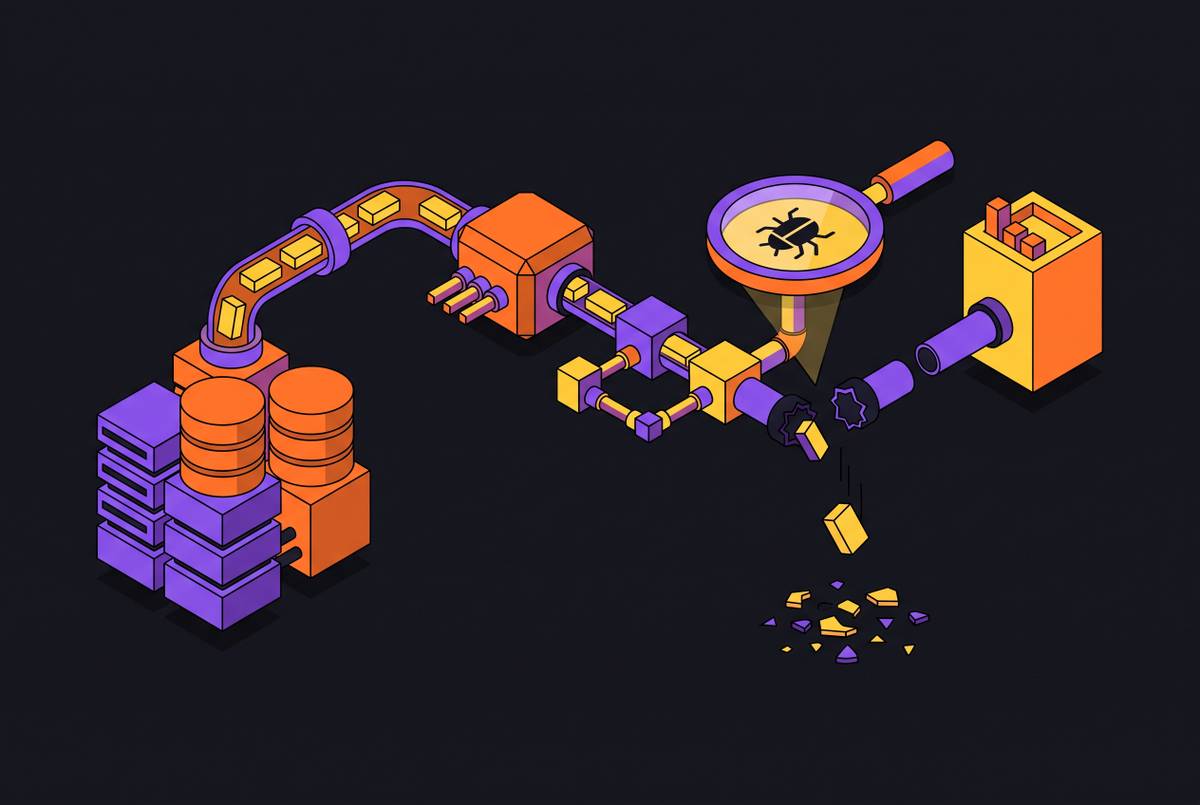
The most dangerous scraper failure in a production AI system is one that looks like success: a 200 response, no exception thrown, and completely useless data delivered downstream. A selector can match nothing and return an empty string. A price field can arrive as free text. Every description in a batch can silently become null. The HTTP layer sees none of this.
Kadoa's 2026 analysis names the problem directly. Extraction is a solved problem. The hard parts are everything else: maintenance when sites change, scaling to thousands of sources, and knowing whether the data is actually right. The failure mode is structurally invisible to uptime dashboards. The request completed, the job status is green, and bad output is already flowing into the LLM pipeline.
How silent data failures propagate through LLM pipelines
A silent data failure does not stay at the scraper boundary. It travels. The propagation path is direct: the scraper returns malformed data, the chunk is embedded as-is, retrieval ranks an empty or garbled chunk, the LLM generates a response grounded in nothing, and the user sees a confident hallucination. One bad field becomes one bad answer.
The stakes are asymmetric. A scraper that fails loudly is fixed immediately. One that silently degrades data quality can run for days or weeks before anyone notices an accuracy problem in the application. LLMs compound the problem. Kadoa's 2026 analysis notes that vision models reading financial KPIs can misinterpret values depending on page layout. Even a successful extraction can carry semantic errors that only a validation layer would catch. The retrieval index periodically poisoned by a broken scraper is not a clean index. It is a randomly degraded one.
The four failure classes a data-layer health framework must cover
Production scraper health monitoring has four distinct failure classes, each invisible to HTTP monitoring and each capable of poisoning downstream pipelines in a different way. Schema non-conformance is the first. Extracted fields arrive in the wrong type or structure. A price comes through as a string. A date arrives as free text. A required field is absent entirely. JSON schema validation against a developer-defined schema catches this class before data moves downstream. Kadoa's 2026 analysis identifies production-system validation layers that check extracted values against expected types and ranges as the mechanism for catching this. It is not optional at scale.
Null and empty-field rate spikes are the second. A selector or semantic extractor that was working begins returning null for a field. Individually, each null looks like missing source data. Collectively, a spike reveals an extractor failure. Tracking null rates per field per run, and alerting when the rate crosses a threshold relative to baseline, surfaces this class.
Volume and coverage drops are the third. The scraper runs and returns 200s, but extracts far fewer records than a comparable prior run. This is a sign of structural drift, anti-bot intervention, or pagination failure that HTTP monitoring cannot see. Kadoa's 2026 scraper review describes validation layers that compare previous run data with current data as a core mechanism for detecting layout shifts. Anomaly detection triggers visual analysis and selector regeneration.
Structural drift is the fourth. The site changes its layout. The selectors no longer map to the right elements. The extractor silently begins returning values from the wrong fields. The schema still validates because the types match. But the values are wrong.
Freshness as a first-class health metric, not an afterthought
A scraper that extracts clean, schema-conformant data on a two-week crawl cycle is still a health liability for any pipeline where the source data changes faster than that cadence. Freshness is not a deployment concern. It is a runtime health concern. If the crawl ran weeks ago and the source changed recently, the data is structurally valid and factually wrong.
A freshness TTL per source, calibrated to how fast that source changes, is the right abstraction. A news feed may need hourly checks. A regulatory document corpus may need weekly ones. A single global value does not work. Monitoring freshness means tracking not just when the last crawl ran but whether the crawl produced data that reflected the current state of the source. A crawl that completed but hit a cached CDN edge or a stale render fails on freshness even if it succeeded on schema.
How self-healing scrapers change the monitoring surface
Self-healing scrapers that automatically regenerate selectors when a site changes reduce structural drift failures. But they introduce a new monitoring concern: the regeneration event itself must be detected, logged, and validated before the repaired extractor goes back into production. Kadoa's 2026 analysis describes this pattern explicitly. The efficient approach uses LLMs to generate deterministic code once, then runs it cheaply at scale, with agents monitoring and regenerating only when needed.
A silent regeneration that produces a worse extractor is a new failure mode unique to this architecture. The system healed itself into a worse state without raising an alert. Every regeneration event should be a monitored state transition. Log the trigger, the before and after extraction samples, and the schema conformance score of the new extractor before it handles production traffic. Run the new extractor against a held-out set of pages with known ground-truth values and compare. If schema conformance and value accuracy both hold, promote it. If not, hold and alert.
Semantic extraction, reasoning about what the data is rather than where it sits in the DOM, degrades more gracefully than selector-based extraction when layouts change. But degrading gracefully is not the same as degrading detectably. Monitoring must still surface when degradation crosses a quality threshold. Kadoa's 2026 analysis notes that LLMs can misinterpret content without guardrails. Graceful degradation needs a quality floor enforced by validation.
Instrumentation patterns for data-layer health in practice
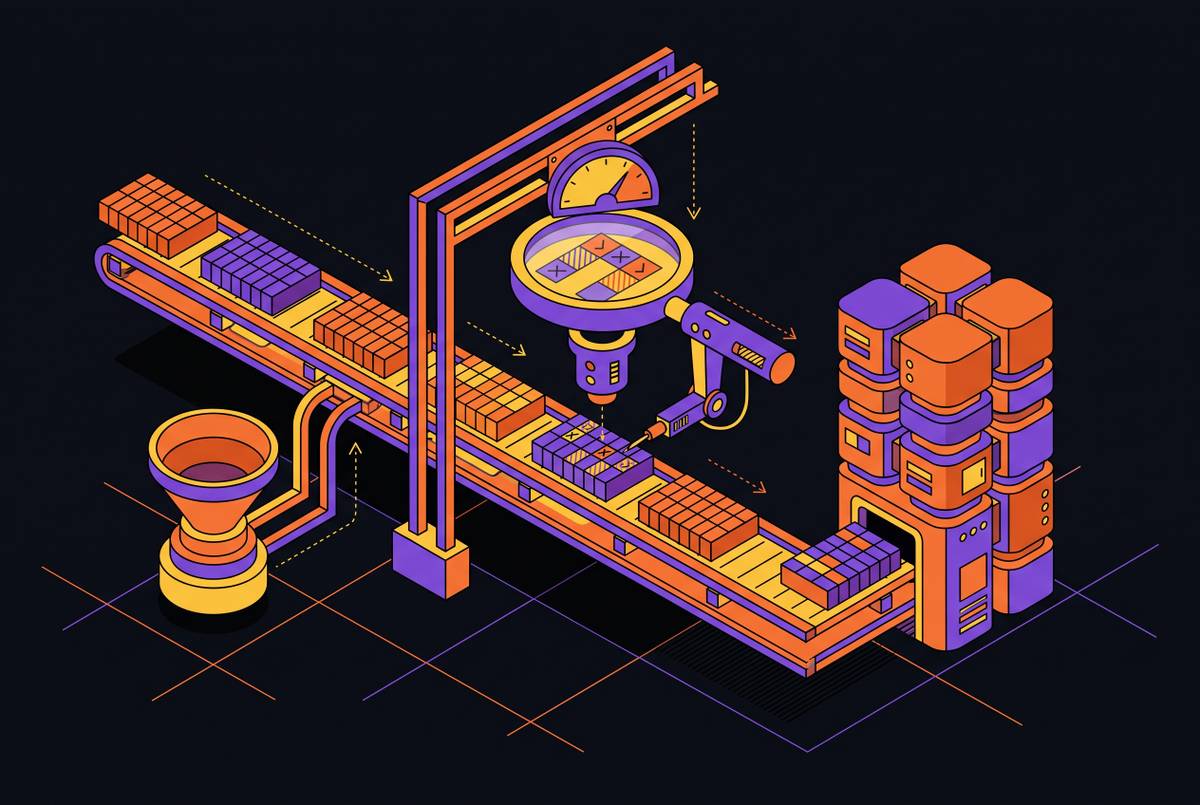
A data-layer health framework requires four instrumentation layers that run after every extraction job, before data enters any downstream pipeline. The schema validation gate is first. Every extraction run passes its output through the developer-defined JSON schema before anything downstream receives it. Any conformance failure triggers an alert and halts ingestion for that batch. Schema-driven extraction, where the developer defines the expected output shape and the extractor fills it, makes this gate straightforward. The schema used to extract is the same schema used to validate.
Field-level null rate tracking is second. For each field in the schema, track the null or empty rate per run and alert when it rises above a baseline threshold. This surfaces partial failures that full-record validation misses. A null rate alert is not a binary pass or fail. The same rate on an optional field is noise. That same rate on a required field is a production incident.
Run-over-run volume comparison is third. Compare record counts and field coverage across consecutive runs for the same source. A drop beyond a configurable threshold signals structural change, anti-bot intervention, or pagination failure. Volume comparison is the first-order signal for layout shifts before a self-healing agent engages.
Freshness TTL enforcement is fourth. Each source has a configured maximum acceptable data age. A monitoring job checks the timestamp of the last successful extraction against the TTL and alerts before the data becomes stale enough to affect pipeline output. TTL should be source-specific, not a global setting. High-volatility sources like pricing pages and news feeds need short TTLs. Low-volatility sources like company About pages and policy documents can tolerate longer ones.
All four layers should emit structured events, not just log lines. An alert that carries the source URL, the failing field, the observed value, and the expected type or range is actionable in minutes. A log line that says "extraction warning" is not. Building and maintaining these four layers in-house, on top of the scraper infrastructure itself, is a non-trivial ongoing commitment.
What the build-vs-API decision looks like when monitoring is factored in
When teams account for the full monitoring stack, not just the scraper itself, the maintenance burden of a homegrown pipeline is substantially larger than the extraction work it was originally built to do. A homegrown production pipeline needs client-side rendering, proxy management, retry logic, schema validation, null rate tracking, volume comparison, freshness enforcement, snapshot retention, and overlap protection. Each component works until a site changes, adds bot defenses, or shifts to client-side rendering. Then it needs repair. Kadoa's 2026 analysis documents a customer spending a large share of data engineering time not building scrapers but fixing them.
The objection to managed APIs is real. A managed API is a dependency, and a dependency can change its pricing, rate limits, or behavior. Teams that have been burned by vendor changes have a legitimate reason to prefer control. The answer is that the relevant comparison is not "our scraper vs. their API." It is "our scraper plus our monitoring stack plus our ongoing maintenance vs. their API plus their monitoring guarantees." The second comparison almost always favors the API for teams whose core product is not the scraper itself.
For agent prototyping via MCP, connect through an MCP server and let the model decide when to scrape at runtime. This is well-suited for dynamic, multi-step workflows. When you move to batch jobs at scale, call the REST API directly for throughput and determinism. Teams whose core product is the scraper, like data vendors and intelligence platforms, have a stronger case for building. Teams building AI products where web data is an input rather than the output should almost always treat the scraper as infrastructure to be bought, not built.
Treating data-layer health as a production discipline, not a deployment checklist
A scraper health framework that runs at deployment and then goes quiet is not a health framework. It is a launch checklist. The discipline is continuous because the sources a scraper targets are continuously changing. Sites change layouts, add bot defenses, shift to client-side rendering, and rotate content. Any of these can silently degrade data quality without breaking HTTP monitoring. A mature posture treats every run as a potential first sign of drift.
A multivocal literature review analyzing 136 papers on ML system monitoring supports this framing. Data quality failures are a distinct monitoring concern from infrastructure failures and require separate detection and escalation paths. The practical organizational shift is to promote silent data failures to first-class production incidents with the same escalation path as infrastructure outages.
The monitoring surface is not static. As the pipeline adds new sources, the schema expands, TTLs need recalibration, and volume baselines need to be re-established. Health monitoring is a living system, not a configuration file written once. The teams that get this right instrument monitoring before they scale, not after. At a small number of sources, a null rate spike is a curiosity. At thousands of sources, it is an incident that has already been silently running for hours. Confirming requests return 200s is table stakes. The real discipline is validating extracted data quality, schema conformance, and freshness before bad output reaches the LLM.