Validating and Correcting Extracted Data Before Pipeline Ingestion
Corrupted extraction silently feeds bad data to agents unless validated at three checkpoints.

Validating and correcting extracted web data before pipeline ingestion is the quality gate that keeps bad extraction from becoming an autonomous agent’s next decision. That gate needs checks after parsing, after extraction, and before handoff, with clear rules for repair, review, and rejection. A successful fetch or a valid JSON object is not enough.
Why extraction errors are uniquely dangerous in agentic AI pipelines
A page returns a bot-detection challenge, but the fetch counts as successful. The agent receives a captcha screen as if it were product content. Nothing has to crash for the pipeline to fail at its purpose. The request worked, but the data is wrong, and an autonomous system can act on it before a person notices.
Traditional data pipelines often had people downstream who could spot a bad report. Agentic systems execute on what they receive, so a corrupted field can become a corrupted action. Less obvious contamination matters too, including navigation menus, cookie banners, footer links, and inline scripts that dilute embeddings and degrade retrieval. Old page content can also remain in the pipeline after the source changes. These are silent failures, which makes them more dangerous than errors that stop processing and demand attention.
What can go wrong at each point between the web and the pipeline
These failures cluster at predictable boundaries between the web and structured pipeline input. At the fetch layer, rendering failures, anti-bot blocks, and network errors can make a failed fetch look like it worked. The response may arrive without the material the pipeline asked for. That is a delivery problem, before the system has even tried to interpret the page.
At the parse layer, the problem shifts from delivery to document structure. A field extractor built around one layout can break when the source redesigns its pages. Different page formats can also produce inconsistent text layers, even when they belong to the same source. The extracted field may hold the wrong material because the parser gave extraction a skewed view of the document.
At the structured output layer, valid JSON can hide invalid meaning. Provider-native structured outputs guarantee syntactic validity, so a date can parse without being plausible and a total can differ from its line items. At the ingestion boundary, an otherwise sound record can be stale because a newer source version exists. Across these locations, recurring symptoms include missing values, mixed data types, inconsistent headers, duplicates, and malformed dates. These symptoms all lead to unreliable input, but they have different causes.
Why a single validation pass at ingestion is not enough
A final schema check sees the record that survived processing, where mistakes introduced or concealed during processing can remain hidden. If parsing puts the wrong content into a field, extraction may still turn that content into a structurally valid value. The final check then accepts a record that fits the schema but misrepresents the source.
Type conversion creates the same blind spot. A transformation can silently coerce a mismatched value into the required type, leaving output that looks acceptable at the final gate. By then, the mismatch that would have exposed the problem is no longer visible in the same form. Even with every check moved earlier, later transformations can still add new errors. Moving every check later increases the cost of reprocessing.
The useful model is a series of checkpoints. In the swimlane model, data moves from API to Validation, then Cleaning, then QA, and finally Warehouse. Each boundary is a place to examine what the previous stage produced. For extracted web data going to agents, that principle becomes three validation points, namely post-parse, post-extract, and pre-handoff.
A stage-by-stage validation framework for post-parse, post-extract, and pre-handoff
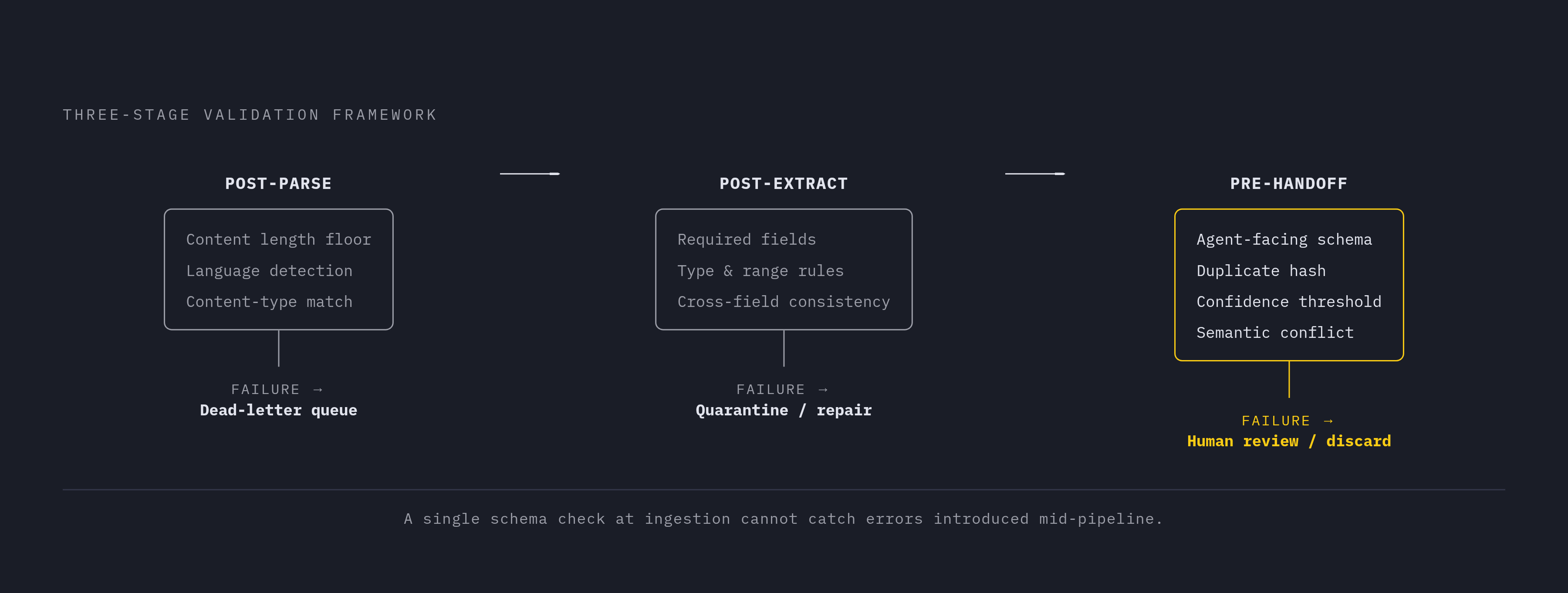
Post-parse validation guards against extraction running on an empty, garbled, or structurally incomplete document. Its input is the parser’s output, and its job is to establish that the output is machine-readable and suitable for extraction. A content length floor checks for empty responses and short bot-detection pages, while language detection helps flag encoding failures that send back garbage text. Content-type validation checks for a different kind of mismatch, such as HTML sent to a PDF parser. Records that fail should go to a dead-letter queue so they remain available for investigation.
Post-extract validation guards against fields that look orderly but carry incorrect values. Required-field checks, type checks, and accepted ranges establish the basic contract, using tools such as JSON Schema or Pydantic. Semantic checks then test how the fields relate to each other, which a type declaration alone cannot do. Totals should match line item sums, dates should be in the required logical order, and entity references on different pages should resolve to the same canonical value.
A currency value can parse as a string but fail an uppercase constraint, while a timestamp can parse as a datetime but violate a rule against future values. Schüssler et al.’s 2026 Astro-COLIBRI study shows why that distinction matters beyond formatting. All Circulars in its operational evaluation corpus made it through the workflow without structural failures, but people still had to audit 210 Circulars to check whether the science in each field was correct. Completing the workflow did not establish that the extracted science was correct.
Pre-handoff validation checks that the final payload is safe for the agent to use. It checks required fields, types, and accepted ranges against the agent-facing schema, rather than relying on checks of pipeline-internal fields. For RAG pipelines, a duplicate hash check keeps content already in the index from being re-ingested, while semantic similarity can help flag information from different pages that conflicts. Fields below a configurable confidence threshold go to human review.
Correction strategies for repair, quarantine, and discard
Detection needs a response chosen in advance. Without a planned response, validation changes where the pipeline stops but gives it no way to recover. Repair a record when the correct value follows from a rule, quarantine it when correction needs judgment, and discard it when the value cannot be recovered from the received content.
Repair in place fits deterministic changes, including normalizing date formats, uppercasing currency codes, stripping known boilerplate patterns, and filling nullable fields with typed defaults. The correction is safe to automate because a defined rule determines the result. Quarantine fits ambiguous values or confidence below the required threshold. A dead-letter queue or human review interface preserves the chance to recover valid data without guessing at its meaning.
Discard fits structurally unrecoverable content, including bot-detection pages, encoding failures, and completely empty responses. Even then, the reason and source URL need logging so the failure can be investigated and retriggered. This differs from silently dropping a record at the first failed check. Every cleaning operation should also be tracked so extraction quality and regressions remain visible over time.
Deduplication needs the same care because records with repeated values may still be distinct. A content hash check distinguishes duplicate content from a URL that returns different material over time. Recovery logic also deserves a place where outputs suffer a systematic, repairable defect. The biological sequence pipeline described in the research brief illustrates this pattern, with only a fraction of extracted sequences passing the first structural filter before repair logic was applied. Classify the failure before deciding that rejection is the right outcome.
Schema drift as the failure mode that schema enforcement creates
Strict enforcement has a real weakness when the source changes but the schema does not. A page redesign, new field, or renamed attribute can make valid source data look non-compliant. A pipeline set up to reject every mismatch may then drop new information while looking as though it works well. The quality gate has become a data loss mechanism because it treats structural change as bad content.
Validation asks whether a record matches the current contract. Monitoring asks whether that contract still matches the source. Rejection rates over time help expose the gap, especially when validation failures suddenly rise for one source. When failures spike like this, the next step should be to look for an upstream change before assuming the source is producing rubbish.
Keep enforcement while adding structural monitoring and alerts for sudden rejection increases. When a structural change is found, it should prompt a schema audit instead of just another scrape based on the same assumptions. That preserves a strict agent-facing contract without pretending that the web will keep its side of the contract forever.
Change detection as the trigger that keeps validation current
A record can pass every check and later become stale when its source changes. Validation performed only at initial ingestion cannot see that transition. Automated change detection supplies the missing trigger by turning a source update into a pipeline event. The resulting work is an automatically triggered new scrape, renewed validation, and re-ingestion.
A webhook can start that chain when a change is detected. The pipeline then re-scrapes the page, runs post-extract validation on the new content, and reconciles differences against the existing index. Conflicting entries can be flagged for resolution without a person having to initiate the process. If the change affects structure, it also prompts the schema review described above.
For RAG, this link directly affects the evidence an agent retrieves. An index that ignores source changes can return answers grounded in content that was accurate when collected but is no longer current. A previously validated record is not a permanent guarantee of freshness. Recency depends on how reliably source changes trigger another pass through ingestion.
Building that trigger is not as simple as comparing raw HTML hashes on dynamic pages. The work can expand to a headless browser, wait logic for asynchronous content, proxies, retries, and snapshot storage. DOM normalization and text-region comparison are then needed before webhook delivery completes the chain. Each addition creates another maintenance burden. Change detection belongs in the quality design because it has its own failure points.
Connecting the quality gate to the agent handoff in practice
The final payload is where these checks become useful to the agent. Validated output should arrive with the text cleaned, the values normalized, and the fields mapped into the format the agent expects. If the agent has to finish those jobs, the pipeline has passed work it should have finished across its quality boundary. That also makes a malformed-input failure harder to trace back to extraction.
The payload needs to carry the information that makes its content usable and accountable. A source URL supports provenance, audit trails, and re-ingestion, while an extraction timestamp supports recency evaluation and staleness detection. A confidence signal or validation status tells the agent or downstream system how much trust to place in each field. The content itself must use the format the agent was built to consume, including JSON for structured extraction or clean Markdown for LLM-ready prose.
For agentic tool use, a scraping API that works with an agent tool protocol can let an agent ask for a scrape, extraction, or brand data lookup without custom integration code at the agent layer. The quality gate then belongs in the API layer, shared across agents. A stitched stack of separate scrapers, crawlers, validation layers, and change-detection tools spreads quality guarantees across systems with different failure modes. One well-designed API returning clean JSON or Markdown can reduce the number of places those guarantees break. At handoff, the test is blunt, either the upstream pipeline has prepared the data for autonomous use, or it has passed the risk to the agent.