The Data Engineer's Toolkit for Production-Grade Web Scraping Workflows
Match each scraping job to its optimal layer, not its most powerful tool.
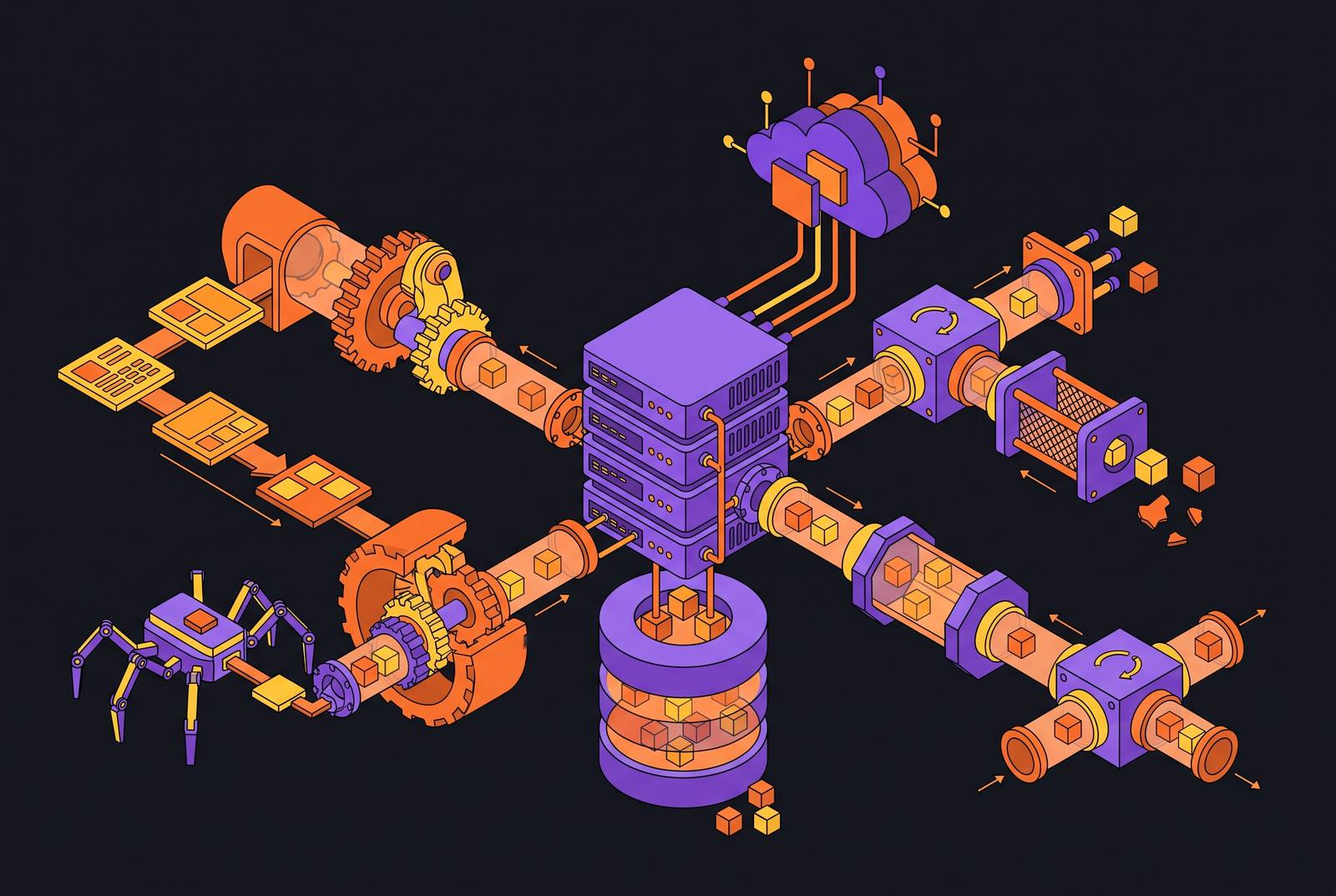
A production-grade web scraping workflow is not a tool choice. It is a stack design, with each layer matched to the narrowest, cheapest technique that handles its subset of pages. The dominant failure mode is applying the right tool to the wrong layer, and the fix is a deliberate hierarchy: API and XHR first, embedded JSON second, browser automation third, and LLM extraction only at the edges.
Why production scraping fails at the architecture level, not the tool level
A team ships an LLM-powered scraper that works on a demo page and returns empty JSON in production because anti-bot defenses blocked the fetch before the model ever saw the page. The extraction model was never the problem. The architecture was, and that is where most production scraping failures live.
Three forces have made these choices higher-stakes than they were a few years ago. Sites are heavier now: single-page applications, lazy loading, and cookie gates mean a simple HTTP request often returns an empty shell. An API such as Context, which converts URLs directly to LLM-ready Markdown and extracts structured data via JSON schema, addresses exactly this downstream requirement.
The naive response to these forces is to reach for a more powerful tool, which skips the question of which layer the problem actually lives on. The old maintenance pattern consumed the vast majority of ongoing developer time in fixes rather than building, a ratio that compounds as sites harden. The answer is not a better single tool but a layered stack in which each job descends only as far as it must.
The four-layer hierarchy and the decision logic for moving down it
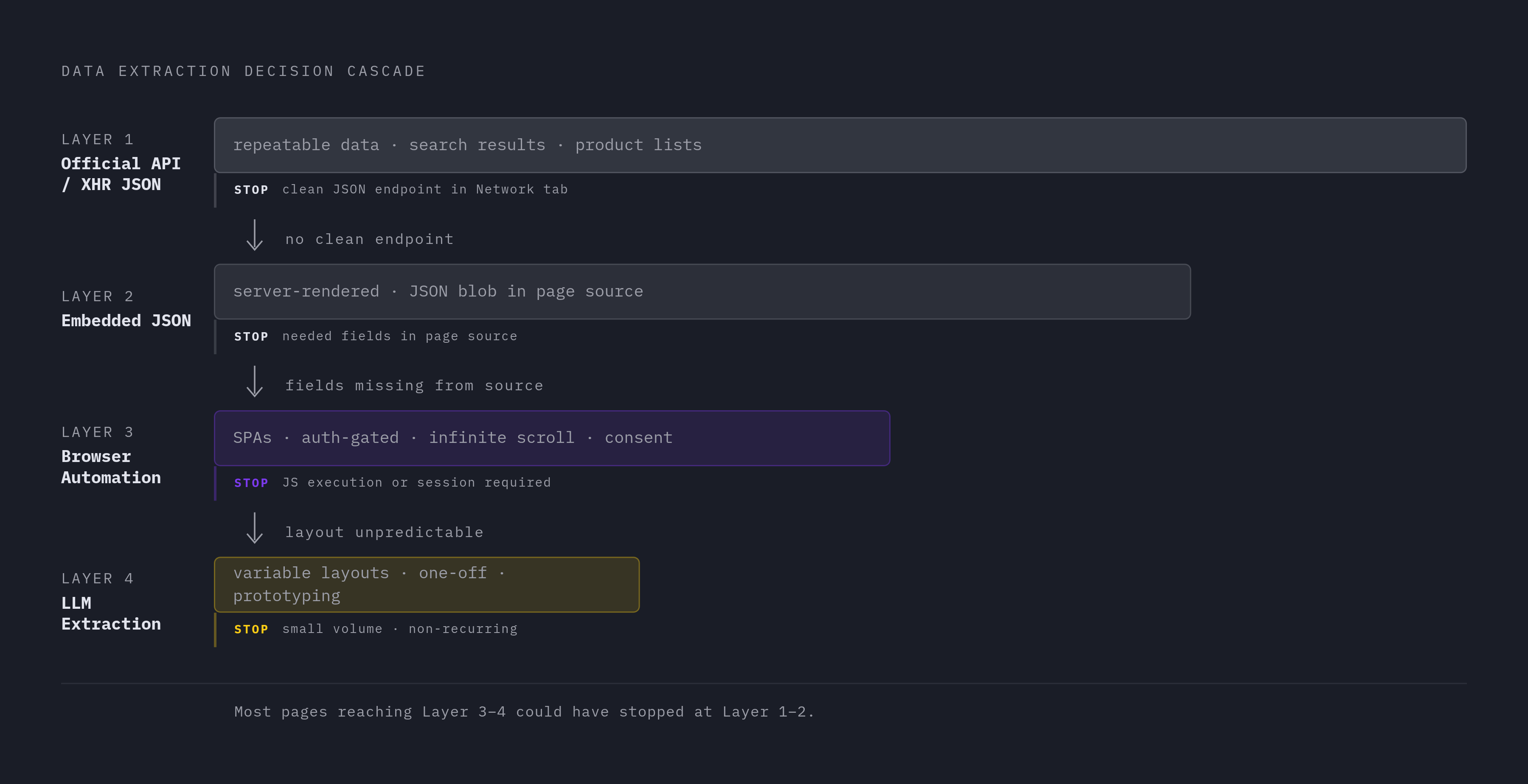
A production scraping stack is an ordered hierarchy, and the discipline is knowing when to descend, not defaulting to the bottom. Layer 1: Official API or XHR JSON. Repeatable data jobs, search results, product lists, profiles, and pagination all fit here. When a clean JSON endpoint exists in the Network tab, there is no reason to parse HTML. Decision gate: does a public API or an XHR endpoint return the needed data? If yes, stop here.
Layer 2: Embedded JSON. Decision gate: does the page source contain a JSON blob holding the needed fields? If yes, parse it directly.
Layer 3: Browser automation. Playwright or a browser agent for rendered pages, auth cookies, infinite scroll, forms, dashboards, and consent flows. Decision gate: does the content require JavaScript execution or authenticated sessions to appear in the DOM?
Layer 4: LLM extraction. Variable layouts and rapid prototyping where selector maintenance is not justified. Decision gate: is the volume small, the layout variable, or the task non-recurring?
Layer 1 and 2 in practice: extracting clean data before touching the DOM
The majority of data that engineers build Playwright jobs for is already available as structured JSON, either through an XHR endpoint or embedded in the page source. Finding it first is the highest-leverage skill in the hierarchy, and it starts in the browser DevTools. Open DevTools, filter the Network tab by Fetch/XHR, and watch the requests that fire on page load or user interaction. The endpoint returning JSON is the scraping target, not the HTML. Modern sites load data through JavaScript calls to internal endpoints, and replicating those requests with a plain HTTP client sidesteps rendering cost entirely. What disqualifies the path is signed tokens that rotate per session, opaque parameters, or a call that requires prior authentication state.
Embedded JSON inspection is the same move without the network traffic. Server-rendered frameworks like Next.js ship data as JSON inside the HTML. Context, used as a dedicated scraping API, normalizes responses into a predictable format for recurring jobs, which reduces the maintenance burden of selector drift as schemas change over time.
AI agents can now do the inspection step themselves, observing a page, finding the cleanest data source, and writing the extraction code. That collapses what was a 15-minute DevTools session into a two-minute terminal command. The agent follows the same hierarchy an engineer would: check for APIs, look at network requests, inspect embedded JSON, and fall back to HTML only when necessary. The key distinction is that the agent does the inspection and code generation, while the resulting extraction job runs as deterministic code.
Layer 3: when and how to use browser automation without making it your default
Browser automation is the right layer for a specific, bounded set of pages, and treating it as the default for all pages creates infrastructure burden without proportional benefit. It is genuinely necessary for a significant portion of the modern web. The argument is against using it indiscriminately, not against using it at all.
The legitimate triggers are precise. Rendered single-page applications where content is absent from the page source. Auth-gated pages that require cookie or token management. Infinite scroll and dynamic pagination. Consent flows that gate content behind interaction. These pages cannot be handled any other way.
What decides production success at this layer is anti-bot handling, the criterion most tool lists underplay. The page behind Cloudflare, DataDome, or a login wall is the page that breaks most AI tools. Fingerprint rotation, proxy management, and behavior mimicry are not optional extras here. They are table stakes, and a browser automation setup that lacks them will fail on any site using a serious protection vendor.
Agentic browser operation has a real place. An agentic browser session is appropriate for complex one-off or adaptive jobs. A production pipeline with a schedule and a monitoring requirement still needs deterministic code, not an ephemeral agent conversation.
Cost discipline is the final constraint. High-volume scraping where a stable API or XHR source exists at Layer 1 should never reach Layer 3. The browser overhead is waste on a job that a plain HTTP client could have handled.
Layer 4: where LLM extraction earns its cost and where it does not
LLM extraction is not a universal upgrade over selectors. It is a trade-off that wins on variable layouts and one-off tasks, and loses on high-volume, latency-sensitive, or financially consequential pipelines. Where it wins is well defined. One-off or rapid-prototyping extractions where volume does not justify selector engineering. The prompt-and-LLM extraction pattern, in which you describe the fields in plain English and get JSON back, requires no selectors at all.
Where it loses matters just as much. Latency-critical paths where throughput slower than selector-based extraction is unacceptable. And unverified production data, financial facts, or personal data, where gaps between instruction and execution are not acceptable.
The defining production challenge is not extraction but controlling the shape and reliability of the output. The correct abstraction is a JSON schema: describe the fields you want, let the LLM map the page to the schema, and schema-driven parsing survives site redesigns where selector-based extraction breaks. Within a single pipeline, the recommended order is fast selectors first, LLM text extraction as fallback, and vision extraction as last resort, since vision models processing screenshots introduce meaningful inference latency.
Self-healing behavior is a genuine maintenance win. LLMs can detect layout changes and re-map extraction logic automatically, which shifts the human role from fixing broken selectors to validating data quality. Accuracy on a clean demo page is not accuracy on a cluttered production page full of navigation, ads, and popups, and no accuracy benefit matters if anti-bot defenses block the fetch.
Structuring the output layer so it feeds AI pipelines without ongoing cleanup
The output layer is where scraping architecture either compounds value into AI pipelines or leaks it. Raw HTML dumps and unstructured text force every downstream consumer to do cleanup work that should have happened once at the source. Raw HTML fails as LLM input because navigation bars, cookie banners, ads, and boilerplate mix with content. Markdown is the preferred intermediate format for RAG because it preserves headings, lists, links, tables, and code blocks, the semantic structure an LLM needs to reason accurately. Code blocks must survive extraction without paraphrase, tables must remain comparable, and headings must signal section boundaries to the chunker.
JSON schema extraction is the right format when the output target is a database, an agent action, or a structured AI tool call rather than a retrieval chunk. The schema is the contract between the scraping layer and every downstream consumer. When the schema is stable, site redesigns do not propagate into pipeline breakage.
Chunk metadata is a production requirement, not a nice-to-have. Freshness itself should be a parameter. Production pipelines need to control when a cached result is acceptable and when a live fetch is required, and a scraping layer that exposes freshness as a configurable setting lets the pipeline tune cost and latency by content type without changing its own logic.
Grounding RAG systems with live web data instead of a frozen index
A RAG system is only as good as the freshness and cleanliness of what it indexes. The structural failure of static RAG is that it can only retrieve documents that were already indexed, so any topic that changes faster than the indexing cadence returns answers that were stale at the moment they were generated. The content categories that go stale fastest are exactly the ones enterprise RAG users most need to trust: pricing, library versions, security CVEs, regulations, and competitive positioning. A static index cannot track any of them.
The production hybrid architecture pairs two paths. Fast-moving queries trigger a live fetch. The scraping layer's freshness parameter is what makes the TTL tunable per content type. A seven-stage pipeline shows where the scraping layer plugs in: query understanding, live source discovery, fetch and clean, chunk and embed, retrieve top-k, ground the generation with citations, and cache with freshness TTL. No chunk, no claim.
The strongest objection to live web grounding is that it does not automatically produce accurate attribution. In a documented audit of commercial generative search engines, only roughly half of generated sentences were fully supported by their cited sources. Explicit citation enforcement and content-hash deduplication catch the two most common failure modes: ungrounded generation and duplicate retrieval inflating confidence.
Feeding agentic workflows with live web data without making the agent the scraper
The architectural error in most agentic scraping designs is treating the agent as the scraper. An LLM operating a browser for every data request is expensive, slow, and fragile compared to an agent that calls a well-designed scraping tool and reasons over the clean result. Agents need web data to behave in a specific way: one URL fetched, rendered, and parsed into clean structure within a single request cycle. The model is waiting on that response before it can act, so latency and freshness matter more than raw crawl volume. For practitioner teams, MCP becomes the standard interface between LLMs and live web data, with the agent calling the tool, receiving structured data in the same request cycle, and acting without a custom wrapper.
What production agentic pipelines still require is everything an agent conversation does not provide: a proper codebase that can be deployed, tested, and monitored, alerts and error recovery, and persistence of results next to source metadata. AI agents handle speed, scale, and adaptation, while human co-pilots provide compliance oversight, quality validation, and strategic interpretation. The realistic target is a hybrid, not full autonomy.
Competitive intelligence makes the agentic pattern concrete. A sudden spike in a particular role category signals a product shift before any press release does. The sequence, schedule-triggered scrape, structured extraction, diff against prior state, alert on threshold, is the agent tool-use pattern in its simplest, most durable form.
Change detection as a first-class layer in production scraping pipelines
Change detection is not a feature to add after a scraping pipeline is working. It is the mechanism that determines whether the pipeline continues working after the first site redesign, and building it naively leads teams to maintain a monitoring product when they needed monitoring as a capability. The naive DIY failure mode is predictable and well documented. Each fix reveals the next layer of the problem, and the team ends up maintaining infrastructure it never intended to build.
Two product categories exist and they are incompatible. Monitoring infrastructure and APIs deliver structured change events to software. Only the second category belongs in a data pipeline.
The API-first pattern for production change detection follows a clear sequence. The change event is the trigger for the extraction layer above it, which is where monitoring and scraping architecture connect. Content-hash metadata from the output layer is what makes the diff reliable, because without a stable canonical and content hash, deduplication and change detection both fail.
Self-healing extraction and change detection are complementary but distinct. Change detection fires the event that triggers re-crawl and re-extraction. Both are needed, and conflating them leaves gaps.
Replacing bespoke scraping infrastructure with a single managed API layer
The full layered stack is individually buildable: fetch layer, JavaScript rendering, anti-bot handling, structured extraction, Markdown conversion, freshness control, and change detection. Maintaining all of it as sites evolve consumes a disproportionate share of engineering time that a managed API is designed to reclaim. The homegrown stack requires a Playwright fleet for rendering, a proxy layer for anti-bot, a parsing pipeline for extraction, a Markdown converter for LLM-ready output, a caching layer with TTL logic, a monitoring stack for change detection, retry and error recovery logic, and an on-call rotation when any of those pieces breaks after a site update. Each component works until a target site changes its layout, adds bot defenses, or shifts to client-side rendering, and then maintenance consumes the team rather than the team shipping features.
The case for consolidation is that one well-designed API should replace the multiple vendors developers currently combine to fill web data gaps. Context's single REST API converts any URL to LLM-ready Markdown, crawls entire websites, extracts structured data via JSON schema, and retrieves brand intelligence, covering the full extraction hierarchy in one surface. Customers including Mintlify, SiteGPT, and Sourcely use it as the data infrastructure layer powering their own products, with the managed API handling the web context layer so their teams go straight to building.
Some teams should keep infrastructure in-house. Targets with negotiated API access remove the anti-bot problem entirely. For most teams building AI-native products, though, these conditions are the exception rather than the default, and the default case favors the managed API.
The compounding benefit is not just reduced maintenance. It is a faster iteration loop. Going from zero to a working extraction call should take minutes, and every hour not spent on scraping infrastructure is an hour available for the product layer that actually differentiates.