Debugging Silent Failures in Scraping Pipelines
Catch data quality failures that pass all standard monitoring checks.

A scraping pipeline can run perfectly and still hand an AI system garbage. That's the subject of this piece: the failure mode where every log looks clean, every status code reads 200, and the data moving downstream is empty, stale, or structurally broken anyway. Traditional monitoring was built to catch crashes: null pointers, dropped connections, 500 errors. It was never built to catch a confident, well-formatted wrong answer.
Picture a naive HTTP scraper hitting a page that needs JavaScript to render its content. The scraper fetches the page, the parser runs against the HTML shell it gets back, and the output is a clean, structurally valid, completely empty document. No exception fires. No stack trace appears. The pipeline logs a successful extraction because, by every measure it knows how to check, the extraction was successful. Nothing crashed. Something still went wrong, and nobody is watching for it.
The four failure classes that stay invisible to pipeline-level monitoring
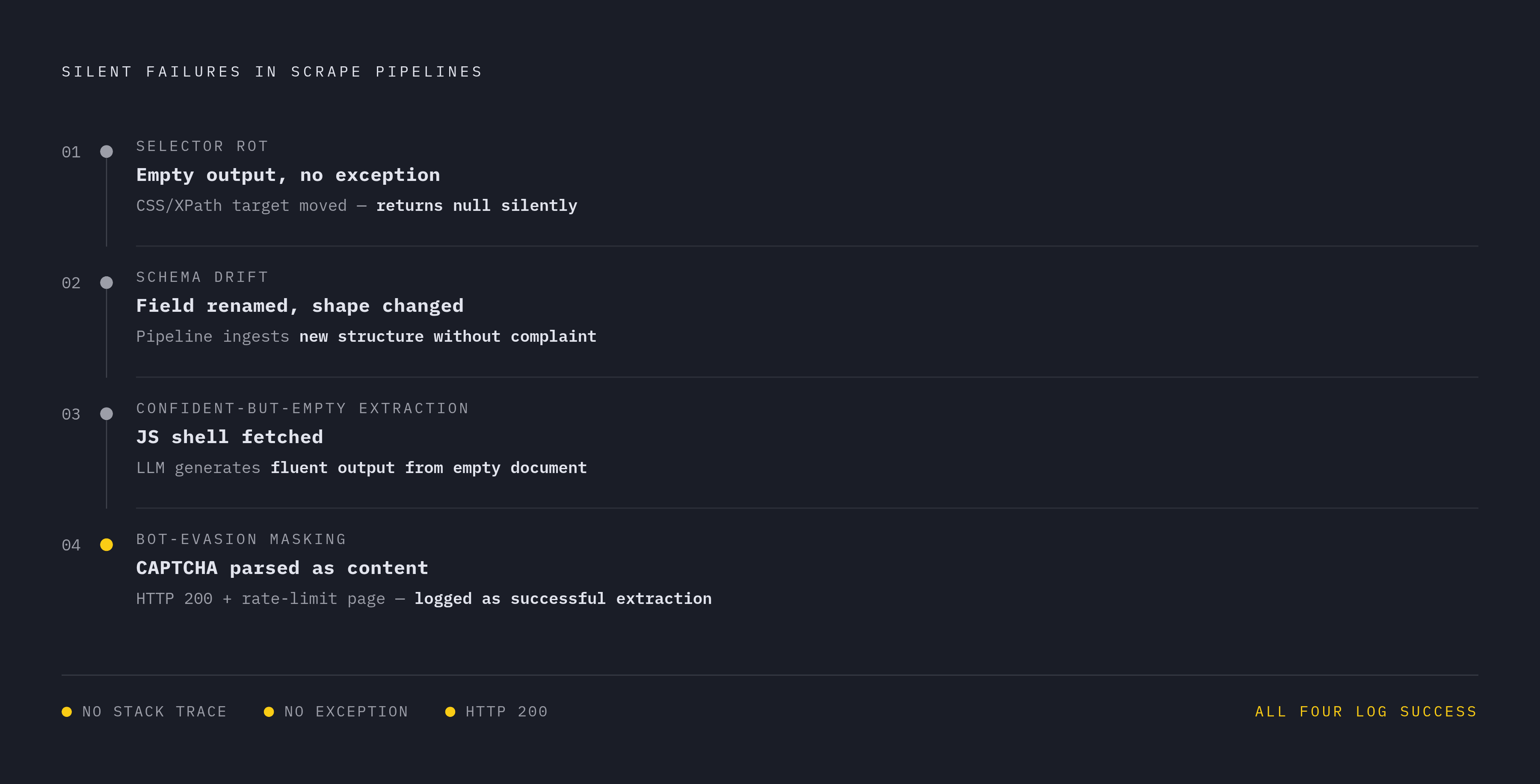
Silent scraping failures are four distinct mechanisms, each one built to slip past a different kind of monitoring, and treating them as a single blob is how teams end up with instrumentation that catches none of them.
The first is selector rot: the CSS selectors or XPath rules a scraper depends on point at page elements that have moved, been renamed, or been removed entirely. The scraper runs, finds nothing at the expected location, and returns empty or partial output without raising a single error, because from the scraper's point of view, it did its job. It asked for a value at a location, got nothing back, and treated the empty result as proof there was nothing there.
The second is schema drift paired with field cardinality shift. A site changes its underlying data model: a field gets renamed, a value's format gets restructured, a key disappears. The pipeline keeps ingesting the new shape without complaint, because nothing in a standard pipeline checks that today's shape matches yesterday's. Catching this kind of drift means watching the distribution of extracted values over time, things like price ranges, availability strings, or how often a given field shows up at all. A sudden jump in that distribution usually means the site changed. A slow, gradual drift with no clean break point can mean something subtler: model behavior drift, in pipelines that use an LLM to do the extracting rather than fixed rules.
The third is confident-but-empty extraction, a close cousin of selector rot, separated out because the failure sits one layer deeper. An HTTP-only fetch hits a JavaScript-rendered page and gets back a near-empty shell. The parser does what it's supposed to do with that shell and produces a structurally valid, completely empty document. Then an LLM downstream takes that empty document and generates output anyway, output with the right format, the right tone, the right shape of an answer, saying nothing at all.
The fourth is bot-evasion masking. The pipeline sends a request and gets back a valid HTTP response, status code 200, real HTML, fully parseable. That HTML might be a CAPTCHA page, a bot-detection redirect, or a rate-limit notice standing in for the actual content. The scraper parses it like it would parse the real page, because structurally, there's nothing wrong with it. The failure here is semantic. The only way to catch it is to check what the page actually says, not just whether it's valid HTML.
Failure compounding as data moves downstream into AI pipelines
Large language models are fluent, tolerant of messy or ambiguous input, and able to generate a confident answer no matter what they're given, and those same qualities let these four failure classes travel downstream instead of getting caught early. A model fed empty, malformed, or boilerplate-heavy content doesn't usually fail loudly. It produces something fluent anyway. Fix the broken pipeline feeding it and the output quality improves immediately, often without touching a single prompt, showing that the model was never the problem in the first place.
Retrieval-augmented generation systems carry this risk sharply. A RAG index reflects the state of the world at the moment of the crawl, nothing more current. If a competitor's pricing page was indexed last Tuesday and the price changed yesterday, the system will confidently cite last Tuesday's number as if it were current fact.
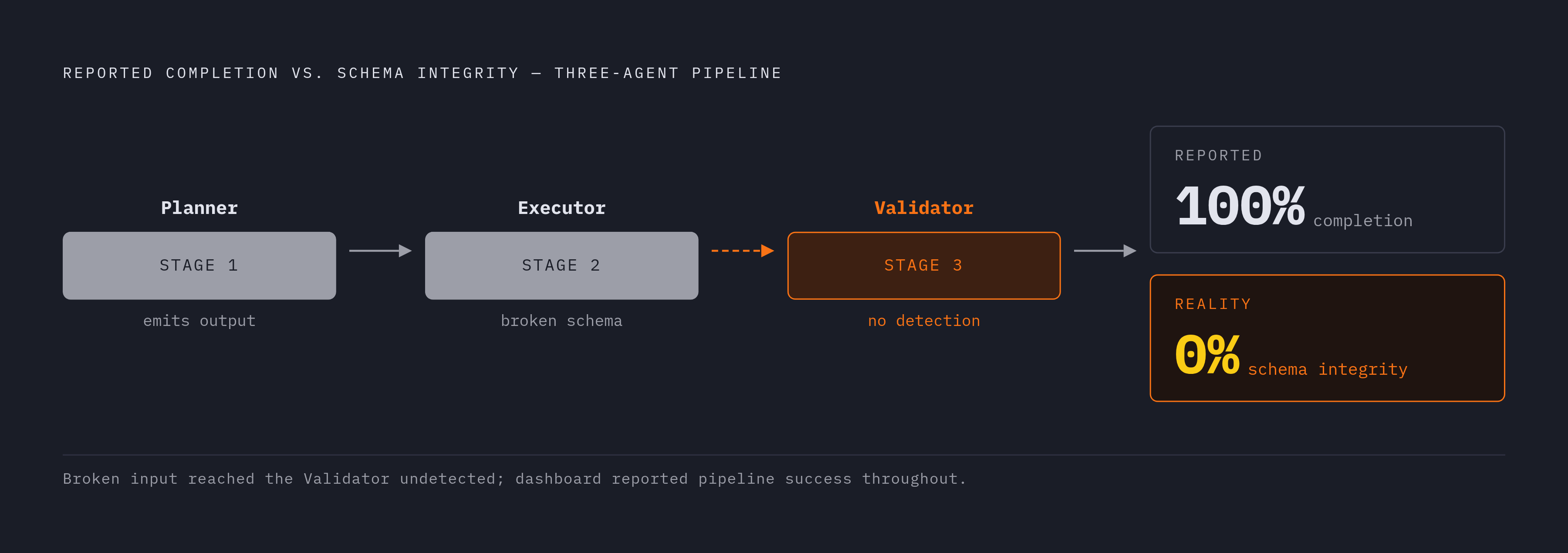
Multi-agent systems compound the problem further, because a single broken tool response can contaminate every step that follows it. In one documented case, a three-agent pipeline (Planner, Executor, Validator, running in sequence) showed a 100% completion rate on its dashboard while its schema integrity sat at zero. The Validator agent received structurally broken input from an earlier stage and had no mechanism to detect that anything was wrong with it.
A paper from Shanghai Qijing Digital Technology frames this as more than a string of individual bugs. It argues that silent failures in LLM agent systems follow from intrinsic properties of language-based autonomous systems running without external, deterministic checks. Under that view, failure rates climb as system complexity climbs, unless deterministic checks get built into every layer. Costs climb right alongside the failures: behavioral drift and cyclic reasoning loops burn through more compute and more tokens, and none of it trips an error signal anywhere along the way.
The wrong unit of measurement for these failures: pipeline-level metrics
Completion rate, uptime, end-to-end accuracy: these are the metrics most teams already track, and they were built for a different kind of failure than the one described above. Applying them to a scraping-fed AI pipeline creates a blind spot because they measure the wrong layer of the system.
A retrieval-augmented pipeline can return coherent, confident-sounding answers even after its retrieval component has quietly stopped working. A generation model that's good enough at its job can paper over bad retrieval. The end-to-end accuracy number holds steady right up until it doesn't, long after the retrieval failure actually started. A pipeline reporting 100% completion while its schema integrity is zero will sail past any dashboard built around uptime alone.
A natural objection here: why not just run more end-to-end evaluations? Offline evals have real value, but they answer a narrower question than it looks like they answer. They tell you how the model performed against a test set last week. They don't tell you whether production quality degraded yesterday, and they can't point to which specific component in the pipeline is responsible when something goes wrong. A paper from IBM Research, presented at ICPE 2026, built and labeled benchmark datasets specifically to study this gap, and the categories it identified, drift, cycles, and missing details in final output, were found to be silent failures that are difficult to detect precisely because they don't trigger explicit error signals. Closing that gap takes instrumentation at the component level, not another round of evaluation at the end.
The deeper issue is organizational: treating AI pipeline monitoring the same way teams treat traditional software monitoring. A service returning a success code is doing its job. A language model returning a fluent, well-formatted answer might be doing its job, or it might be confidently wrong, and a success code can't tell the difference.
Instrumenting at the component level
Catching these failures means building checks at the point of extraction, not after the data has already moved three stages downstream. The later a check runs, the more stages of corruption have already happened before anyone notices.
Start inside the scraper itself. A type mismatch or a null field is cheap to catch at the moment of extraction and expensive to debug once it's buried in later pipeline stages. Use explicit nulls for missing values, never a silently omitted key: a missing price field is ambiguous on its own, but a field written as "price": null tells every downstream consumer what happened and why.
Layer in content-level validation to catch bot-evasion masking. A CAPTCHA page and a real product page can both return a 200 status code with fully parseable HTML, so structural validity alone proves nothing. Checking for expected semantic content, things like a minimum content length, the presence of specific keywords, or a structural fingerprint of what a valid page from a given source normally looks like, catches the cases that status codes miss entirely.
Track field cardinality and distribution over time as a third layer. Watching how often fields appear, and what range of values they take, turns schema drift from invisible into measurable: a sudden step-change in the distribution usually points to a site redesign, while a slower drift without a clean break can point to model behavior drift in pipelines using LLM-based extraction.
Run scheduled selector and schema health checks against known-good reference pages. A selector that returned content last cycle and returns nothing this cycle has rotted, and catching that on a schedule beats discovering it when a user or a downstream agent complains.
For multi-agent systems, replace completion rate with schema integrity rate as the primary health metric. A pipeline that finishes and reports success while carrying corrupted fields is in worse shape than one that crashes outright, because the crash gets caught and fixed immediately while the corruption ships quietly.
Finally, watch what happens during model fallback. When rate limiting forces a pipeline to switch to a fallback model, the payload has to get rebuilt to match that model's specific API contract. Forwarding the original payload unchanged breaks schema integrity without raising any error at all, a failure mode that's been documented in engineering analyses of LLM fallback behavior.
Each of these checks catches a different failure class from the taxonomy above. None of them alone covers the full picture. Together, they close most of the gap that pipeline-level monitoring leaves wide open.
Change detection as a first-class pipeline input, not an afterthought
Selector rot and schema drift are the normal condition of scraping live websites. A pipeline that doesn't actively detect source changes will keep cycling through the same failures indefinitely, each time looking like a fresh surprise.
Automated systems need machine-readable signals of change, not a screenshot a human has to eyeball. A structured diff, something that states precisely which fields changed and how, can feed directly into a pipeline: a webhook detects a content change and triggers a re-scrape, a re-index, a data enrichment step, and a notification, all without anyone sitting in the loop watching for it. Content hashing at the record level gives this a solid foundation: store a hash of each fetched record, compare it against the previous hash on the next pass, and any mismatch tells the pipeline something changed and needs a decision.
This matters most for RAG pipelines, where the freshness gap is structural. An index reflects the state of the world at the moment of the crawl, nothing more current than that. Without a signal that a source has changed, nothing tells the pipeline it needs to re-crawl, re-chunk, re-embed, or update that index, so the gap between what the index says and what's actually true keeps widening without anyone noticing. Some of the newer approaches push this further still: systems where an agent detects that an extraction has broken and rewrites its own extraction strategy in response, a self-healing approach that was starting to appear in production tooling as of mid-2026.
Homegrown scraping stacks and their growing silent failure surface area
A scraping stack that has to handle JavaScript rendering, bot evasion, selector upkeep, change detection, and provenance tracking isn't something a team builds once and leaves alone; it's an ongoing source of exactly the silent failures covered in the sections above, and that surface area only grows as the stack grows.
One documented build-out, from the team at 7Seers working with 47Billion, traces the shape of this clearly. Naive HTTP scraping returned empty documents without raising a single error. Adding Playwright rendered the JavaScript correctly, until bot detection started blocking requests. Each new layer solved the failure class it was built for while adding a fresh layer of operational overhead for the team to maintain going forward.
This is the real fork in the road for teams building scraping infrastructure: build it in-house, or buy a managed layer that already handles it. Assembling scrapers, headless renderers, diff engines, version stores, and retry logic internally keeps the entire failure surface inside the organization, invisible until something breaks downstream. A managed API that handles these layers provides observability and maintenance as part of what's being paid for, rather than as work a team has to build and carry on its own.
Binding extraction to a typed JSON schema is the right fit for AI pipelines specifically, whichever path a team takes to get there. A schema-driven approach to extraction produces verifiable output at the moment of extraction, catching type mismatches and null fields before they ever reach a vector index or get handed to an agent downstream.
The instrumentation decisions that must happen before deployment, not after the first failure
Component-level instrumentation is rare because it requires decisions made before a pipeline goes live, and most teams only start instrumenting after something has already broken in production and someone has noticed.
Start by defining correctness at the component level before the pipeline ever runs in production. A service returning a success code is functioning by the old definition of functioning. An extraction module returning a coherent output may or may not be doing the job it was built to do, and that distinction has to be written into the pipeline from day one, not bolted on after the fact.
A minimum viable instrumentation stack for a scraping-fed AI pipeline covers a short, specific set of ground. Every record needs provenance fields: a source URL, a fetched-at timestamp, a content hash, and a parser confidence score. Extraction needs content-level validation, checking what the page actually says, not just whether the output object is structurally valid. Field values need cardinality monitoring with alerts on distribution shifts, so drift gets flagged. Schema integrity needs to replace completion rate as the primary health metric for the pipeline. Source URLs need change detection wired directly into re-crawl and re-index triggers, not reviewed manually on some irregular schedule. Every agent interaction with the scraping layer needs tool call tracing, so a broken response can be traced back to its origin three stages downstream.
Prompts, extraction schemas, and selector configurations deserve treatment as deployable infrastructure in their own right: version them, test them, build in the ability to roll them back. A schema change that quietly alters field cardinality is a deployment event, not a minor configuration tweak, and it should get reviewed with the same seriousness as a code change to the pipeline itself.
The entropy thesis out of the Shanghai Qijing Digital Technology paper makes the case for doing this work before the first failure. Silent failures are the expected behavior of a structural property built into LLM agent systems, and that failure rate rises as system complexity rises, unless deterministic constraints get built in at every layer from the start. Catching a broken field at the point of extraction costs a fraction of what it costs to trace that same corruption back from a vector index or an agent's final output, after it has already shaped the answers a system has been confidently giving out.