From Raw HTML to Typed Schema How Web Data APIs Feed LLM Agents Without Scraping
Schema-driven APIs deliver fresh, structured data agents can use without scraping.

A web scraping API for AI agents and LLM pipelines should return clean Markdown or schema-defined JSON. The decisive feature is the output contract. Moving rendering, access handling and extraction behind that contract closes the gap between the web as published and the fresh, structured input agents need.
Why LLM agents fail when their data layer stays raw
An agent asked about a current security CVE can return a confidently wrong answer because the retrieved document predates the vulnerability. The model may reason correctly from what it receives and still fail the task. Its input is already out of date. Replacing the model does not repair that gap, because the missing information sits upstream of the reasoning step.
Embedding-based retrieval-augmented generation, or RAG, can only retrieve documents that have already been indexed. When prices, library versions or regulations change faster than the indexing schedule, retrieval returns yesterday’s evidence for today’s question. Coverage gaps make the problem worse when the relevant page was never indexed at all. Even a cached snippet can contradict the live page. A model’s frozen training data cannot reliably fill these gaps, since it cannot account for changes after its snapshot.
Freshness is only half of the input requirement. The agent also needs information in a form it can use without first reconstructing the source’s meaning and structure. A live fetch addresses age, but not necessarily usability. That is why the data layer, rather than model quality alone, is the bottleneck this architecture must address.
Why raw HTML is an unusable input, not just an inconvenient one
The first HTML response may have almost none of the content a person sees when visiting the page. Many modern web apps populate their pages through JavaScript after the browser loads the document. Until that hydration finishes, the response is a shell. An agent that treats the shell as complete evidence can produce an answer from effectively empty data, even though the information exists on the site.
Anti-bot systems check more than the request’s IP address. TLS fingerprinting examines the cryptographic handshake to identify the runtime, while JavaScript probes look for signs of a headless browser. Behavioral analysis can flag deterministic request patterns even when they come from residential IPs. Getting a request through takes access infrastructure as well as the URL.
The HTML that comes back mixes useful content with navigation, advertising, scripts and boilerplate, and its document structure is built for the website. Keeping the relationships the agent needs takes more than removing tags. Rendering, access handling, cleaning and structure preservation each take their own engineering work and upkeep. Raw HTML is unusable as the finished data contract because it leaves that entire stack unresolved.
What a web data API actually does between the URL and the agent
A raw fetch returns the page’s source response, which may be an unpopulated shell or a document crowded with unrelated material. A schema-first API call instead returns the fields the developer requested, extracted from the populated page. The response undergoes a transformation from a website’s presentation format into the application’s input format.
That transformation begins in a real browser environment. The API waits for JavaScript hydration signals and takes a copy of the document with all its content in place before parsing starts. Proxy rotation, session handling and behavioral jitter are in the infrastructure layer, which handles access attempts and retries so the agent can reason without taking on that work. These operations do not disappear because the caller sees one endpoint. The provider takes on the work the caller would otherwise maintain.
Once the content is there, extraction strips out navigation, ads, scripts and boilerplate. The remaining information can become clean Markdown for reading and grounding, or structured JSON for field-based work. Those outputs serve different needs. Markdown preserves useful source material in a token-efficient form, while schema-driven extraction maps that material into a structure defined before the request.
For a pricing task, the distinction is between receiving a page that contains prices and receiving structured price fields. Receiving relevant values already mapped to their fields is what “without scraping” means from the application’s side. The pipeline consumes a data service rather than owning the browser, access and extraction machinery behind it.
Why schema-first delivery is the right abstraction level for agent pipelines
Schema-first delivery is the right boundary because an agent needs a defined contract. A developer-defined schema records domain knowledge about which fields the task requires and how they fit together. The agent can then traverse that structure deterministically. Interpretation still happens during extraction, but it is separated from the reasoning that uses the extracted facts.
The WebLists paper shows why that separation is necessary. Its schema-bound extraction tasks produced recall of only around three percent for LLMs with search capabilities and roughly thirty-one percent for state-of-the-art web agents, despite their stronger performance on question-answering tasks. Finding an answer is not the same as extracting a dataset. Search access does not, by itself, give an agent the ability to return complete information in a required structure.
The schema also provides a more durable boundary than a page’s layout. A CSS selector depends on the document retaining the arrangement the scraper expects, so a layout change can make it return nothing or the wrong field. Semantic extraction instead follows the meaning of the content. As long as that content remains present, it can adapt to new document structures without selector upkeep. This puts the contract closer to the task than to the page’s design.
Schema rigidity is the strongest objection to this approach. If a provider changes its output format, a pipeline built around the old format can break, and the provider determines how much flexibility the interface allows. Schema version management is nevertheless a narrower problem than maintaining access infrastructure and selectors across changing websites.
LLM extraction fits variable layouts and tasks that need schema flexibility, while selectors fit high-volume, cost-sensitive pipelines with stable layouts. Clean Markdown is still useful when the agent needs to read source material. But when a task requires structured facts, returning prose and asking the agent to reconstruct the contract places the work on the wrong side of the boundary.
How live fetch and cached retrieval split the work in production
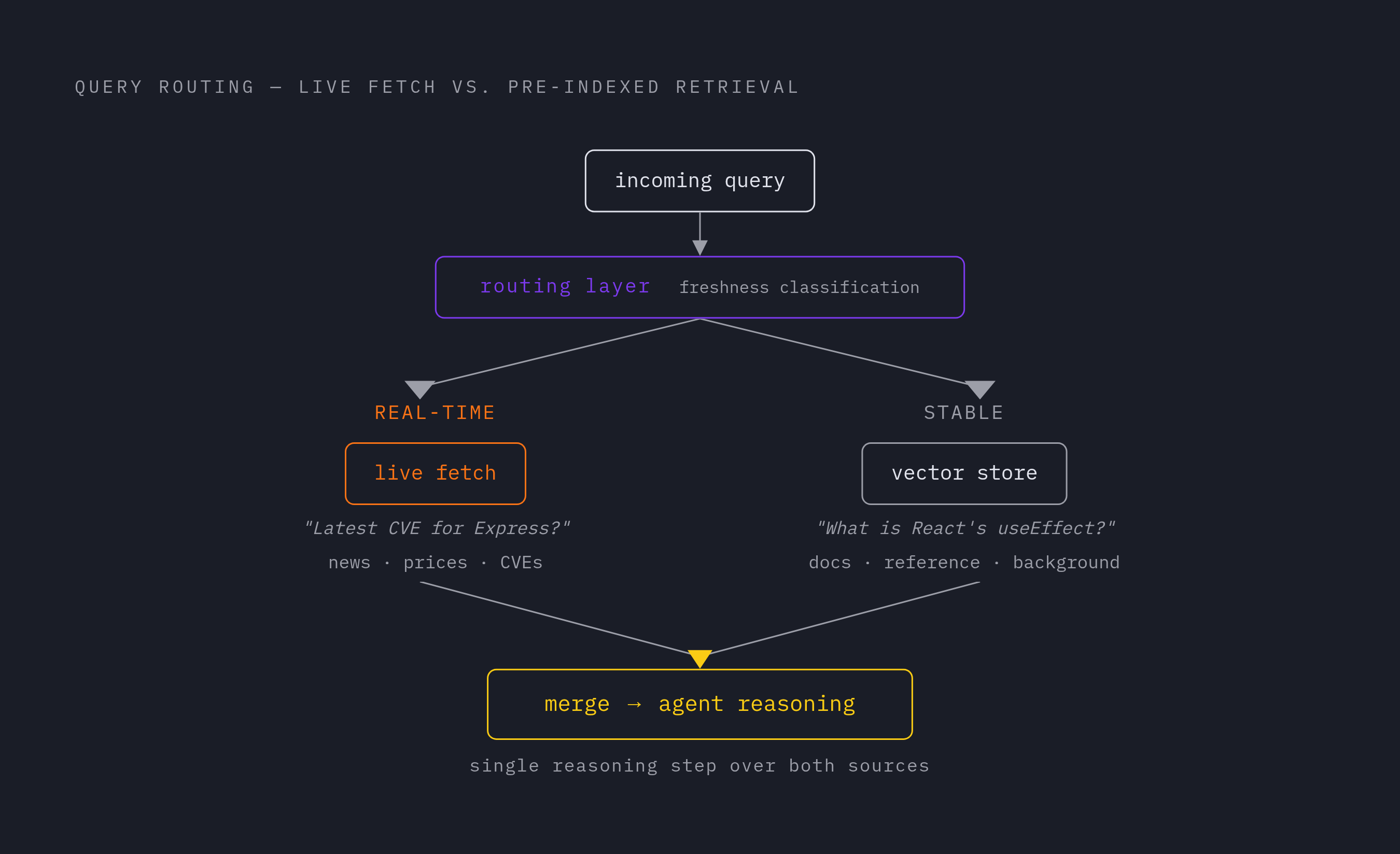
Schema-first delivery does not require a fresh browser session for every question. Production pipelines divide retrieval by how quickly the requested information becomes stale. The routing layer first classifies the query’s freshness requirement, then chooses a source. That decision belongs before retrieval, because fetching everything live spends time on information that a cache could safely supply.
Real-time content, including news, prices, financial data and security CVEs, belongs in the live-fetch tier when age would invalidate the answer. Reference documentation and stable background material belong in pre-indexed retrieval tiers where latency is lower. The question determines which path makes sense. “What is React's useEffect?” does not require a live fetch, while “Latest CVE for Express?” does.
A mixed question draws its time-sensitive portion from live extraction and its background knowledge from the vector store. The outputs merge before the agent reasons over them. This preserves the value of existing retrieval infrastructure without treating its indexed snapshot as a complete account of the current web.
Live access still adds latency, so predictable changes can be handled with caching under a freshness TTL. That expiry period governs how long a fetched result remains eligible for reuse. It helps the routing layer choose when to use recent cached data and when to fetch again. The architecture therefore limits expensive work according to need while preserving the output contract.
What schema-first extraction looks like across three concrete agent use cases
RAG grounding needs fresh evidence without discarding the embedded documents already available to the system. A live crawl can extract clean Markdown from relevant URLs at query time and feed it into the same retrieve-and-rerank pipeline as those documents. The retrieval system gains current material without changing its basic job.
Brand and company intelligence needs a more explicit schema. Instead of mining HTML for logos and visual clues, an application calls an endpoint with a URL and receives structured brand fields covering logos, colors, typography and other signals. Brandfetch’s Brand API provides structured brand data programmatically.
Taste Labs’ Brand API, launched September 15, 2026, extends that contract into a design system. Its extractor covers logos, colors, typography, layout, components, motion, textures and shadows. Its search endpoint takes natural-language descriptions and uses them to find reference brands. A separate verifier compares generated work with a reference brand and returns a score, written criticism and structured instructions for a subsequent generation loop.
General Intelligence Company of New York, the first published customer, incorporated the API into its Cofounder product. The product makes assets for work in marketing, sales, engineering and operations. This gives the schema a concrete downstream purpose. It connects source brand information to asset generation, rather than leaving a model to infer a design system from a web page each time.
An agent watching competitor pricing, regulatory updates or software changelogs needs alerts for meaningful changes, filtering out timestamps, rotating testimonials and minor layout shifts. With Semantic-diff mode for whole-site monitoring, the developer can describe in natural language which changes matter. The API checks pages against those instructions, so monitoring can focus on newly announced products and ignore unrelated changes in how pages look. In this case, the extraction contract defines not just which content to read, but which differences deserve further action.
Where the extraction problem is heading as websites begin exposing typed tool surfaces natively
Websites that publish their own typed interfaces could eventually remove much of the need to reconstruct data from rendered pages. WebMCP uses a JSON schema as its underlying data contract. That is the same abstraction schema-first extraction APIs deliver. The website declares the structure directly, while an extraction service derives it from published content.
The direction is toward machine readability, actionability and reliable decisions as website design requirements. This remains a forward signal. Teams building now still need to turn what sites publish for human visitors into structured input that agents can use. The schema-first pattern is durable because the agent’s contract can stay the same while the source of that contract changes.
Security is a separate condition of that transition. The U.S. National Security Agency stated in a May 2026 report that MCP’s rapid proliferation had outpaced development of its security model. Teams adding MCP-integrated data tools should review their security as part of that work. A typed interface defines the shape of an exchange, but does not settle its security. Whether the data arrives through live extraction or a native site interface, reliable agent work starts with a usable contract and the infrastructure needed to support it.